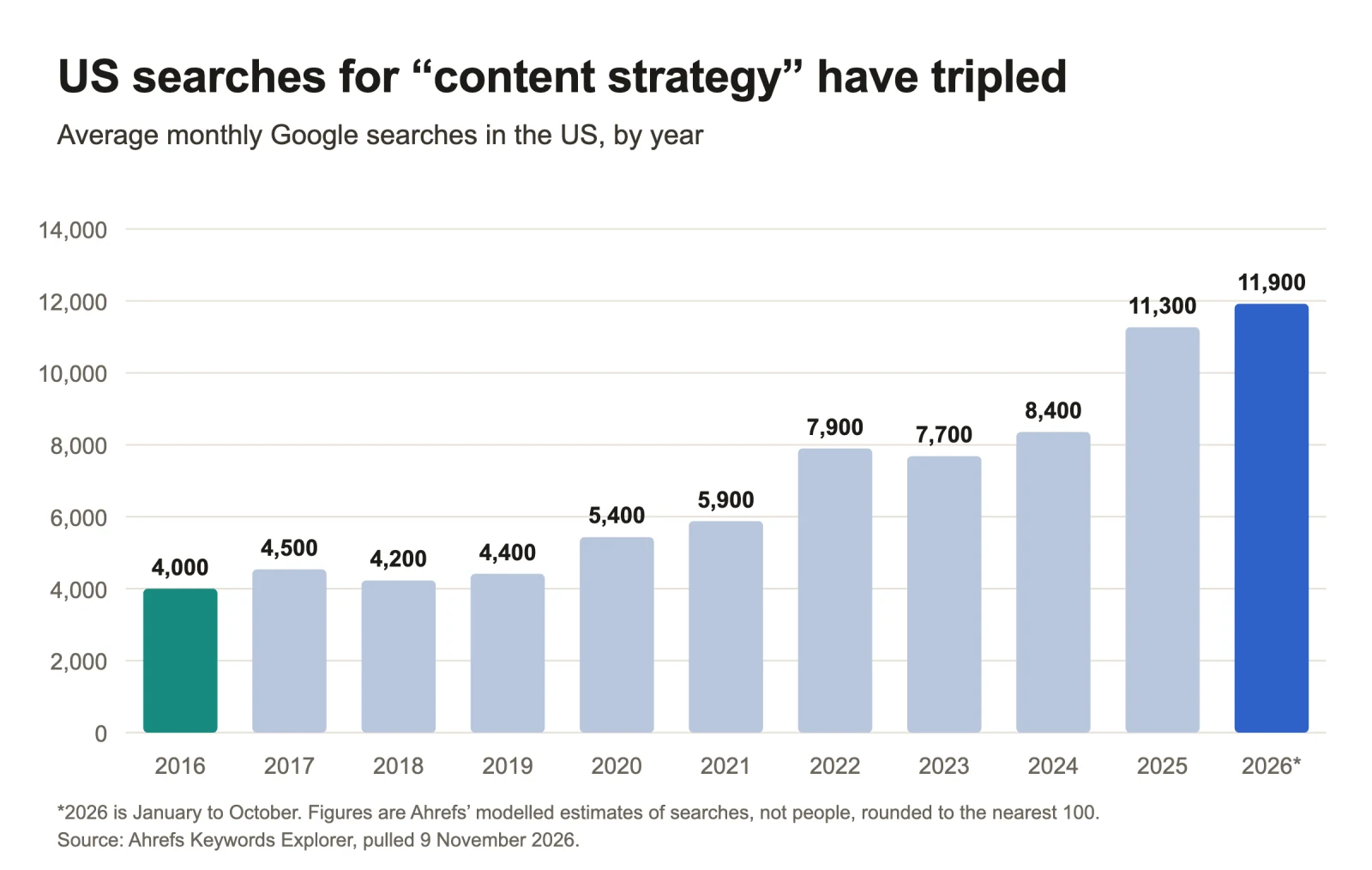
<?xml version="1.0" encoding="utf-8"?><feed xmlns="http://www.w3.org/2005/Atom" xml:lang="en-GB"><generator uri="https://jekyllrb.com/" version="4.4.1">Jekyll</generator><link href="https://www.stevenwilsonbeales.com/feed.xml" rel="self" type="application/atom+xml" /><link href="https://www.stevenwilsonbeales.com/" rel="alternate" type="text/html" hreflang="en-GB" /><updated>2026-11-13T14:11:49+00:00</updated><id>https://www.stevenwilsonbeales.com/feed.xml</id><title type="html">Steven Wilson-Beales</title><subtitle>UK-based SEO, AI visibility and content strategy consultant for publishers, newsrooms and digital media brands.</subtitle><author><name>Steven Wilson-Beales</name><email>info@stevenwilsonbeales.com</email></author><entry><title type="html">Content strategy is back. The hard part never went away.</title><link href="https://www.stevenwilsonbeales.com/post/content-strategy-is-back/" rel="alternate" type="text/html" title="Content strategy is back. The hard part never went away." /><published>2026-11-09T00:00:00+00:00</published><updated>2026-11-09T00:00:00+00:00</updated><id>https://www.stevenwilsonbeales.com/post/content-strategy-is-back</id><content type="html" xml:base="https://www.stevenwilsonbeales.com/post/content-strategy-is-back/"><![CDATA[<p>Content strategy is back in the spotlight. According to Ahrefs, US searches for the term reached around 12,000 a month in 2026, roughly three times the 2016 level.</p>

<p>The job market tells a more revealing story. Of 20 recent UK content strategist job ads I reviewed, 14 mentioned video and eight named TikTok, Reels or Shorts. Several wanted creator or user-generated content experience. Ahrefs also estimates that US searches for “youtube content strategy” have more than tripled since 2024.</p>

<figure>
  <img src="/assets/images/blog/content-strategy-is-back-ahrefs-chart.webp" alt="Bar chart of average monthly US Google searches for content strategy by year, from Ahrefs. Searches rise from about 4,000 a month in 2016 to 11,900 in January to October 2026, with big jumps in 2022 and 2025." width="1600" height="1014" loading="lazy" style="width:100%;height:auto" />
  <figcaption>US searches for "content strategy" have roughly tripled since 2016. Ahrefs modelled estimates; 2026 covers January to October.</figcaption>
</figure>

<p>But a TikTok plan isn’t a content strategy. The bigger challenge is deciding what your organisation stands for, and so what it should say, to whom, where and why. Zero-click search, changeable social feeds and AI answers all make that question harder to avoid. An influential model from 2018 is still the best place to start, and I think it’s worth updating for AI.</p>

<h2 id="what-content-strategy-actually-is">What content strategy actually is</h2>

<p>Kristina Halvorson did more than anyone to establish content strategy as a discipline. She didn’t coin the phrase. That dates back at least to 2002, when Ann Rockley used it in the title of <a href="https://www.peachpit.com/store/managing-enterprise-content-a-unified-content-strategy-9780735713062">Managing Enterprise Content: A Unified Content Strategy</a>, co-written with Pamela Kostur and Steve Manning.</p>

<p>But it was Halvorson’s 2008 <em>A List Apart</em> essay, “<a href="https://alistapart.com/article/thediscipline/">The Discipline of Content Strategy</a>”, followed by her 2009 book <a href="https://www.peachpit.com/store/content-strategy-for-the-web-9780321808301">Content Strategy for the Web</a>, that helped bring the discipline into the mainstream. On her agency’s blog, one definition she offers is:</p>

<p><em>“Content strategy guides the creation, delivery, and governance of useful, usable content.”</em></p>

<p>She also says it connects content with business goals and user needs. Yet too often, content strategy gets reduced to an editorial calendar: what are we posting on Tuesday?</p>

<p>Today’s video-heavy job ads risk repeating that mistake. A channel plan needs a strategy behind it. Cue the evil mastermind hovering over a big red content strategy button.</p>

<p>And a white cat. Don’t forget the cat.</p>

<h2 id="why-content-strategy-matters-more-now">Why content strategy matters more now</h2>

<p>Brands and publishers face a familiar problem with a new urgency: search is sending fewer people to their websites. <a href="https://sparktoro.com/blog/in-2026-less-than-one-third-of-google-searches-still-send-a-click">SparkToro found</a> that in the first four months of 2026, 68% of Google searches in the US ended without a click, up from about 60% in 2024. SparkToro suggests AI Overviews are likely to be a significant factor. In February 2026 <a href="https://ahrefs.com/blog/ai-overviews-reduce-clicks-update/">Ahrefs found</a> that when an AI Overview appears, the top-ranking page gets around 58% fewer clicks. <a href="https://www.pewresearch.org/short-reads/2025/07/22/google-users-are-less-likely-to-click-on-links-when-an-ai-summary-appears-in-the-results/">Pew Research saw the same pattern</a> in July 2025, when it found that people clicked a link on 8% of visits to a results page with an AI summary, against 15% without one. ChatGPT, Gemini and Perplexity now answer questions that used to send a visitor to your site.</p>

<p>That changes the questions clients ask me:</p>

<ul>
  <li>How do we pivot when the clicks dry up?</li>
  <li>Do we need to rethink our brand positioning, or just our tactics?</li>
  <li>How much should we put into any one channel?</li>
  <li>Should we be making creator-style videos because that’s what the algorithm rewards?</li>
</ul>

<p>These are content strategy questions. Answering them is one thing; getting an organisation to act on the answers is another.</p>

<p>That’s where ‘the quad’ comes in.</p>

<h2 id="the-content-strategy-quad-for-the-ai-era">The content strategy quad for the AI era</h2>

<p><a href="https://www.braintraffic.com/blog/new-thinking-brain-traffics-content-strategy-quad">Halvorson’s Content Strategy Quad is still one of the clearest ways to think about the discipline.</a></p>

<p>In Brain Traffic’s version, the top half covers content design (editorial strategy and experience design) and the bottom half covers the systems underneath it (content structure and process design).</p>

<p>I’ve used it for years to help clients connect their publishing challenges to practical decisions.</p>

<p>Much of AI search optimisation already fits within the model: structure addresses machine delivery, experience covers the wider ecosystem, editorial defines the voice, and process determines who decides. The original still holds up.</p>

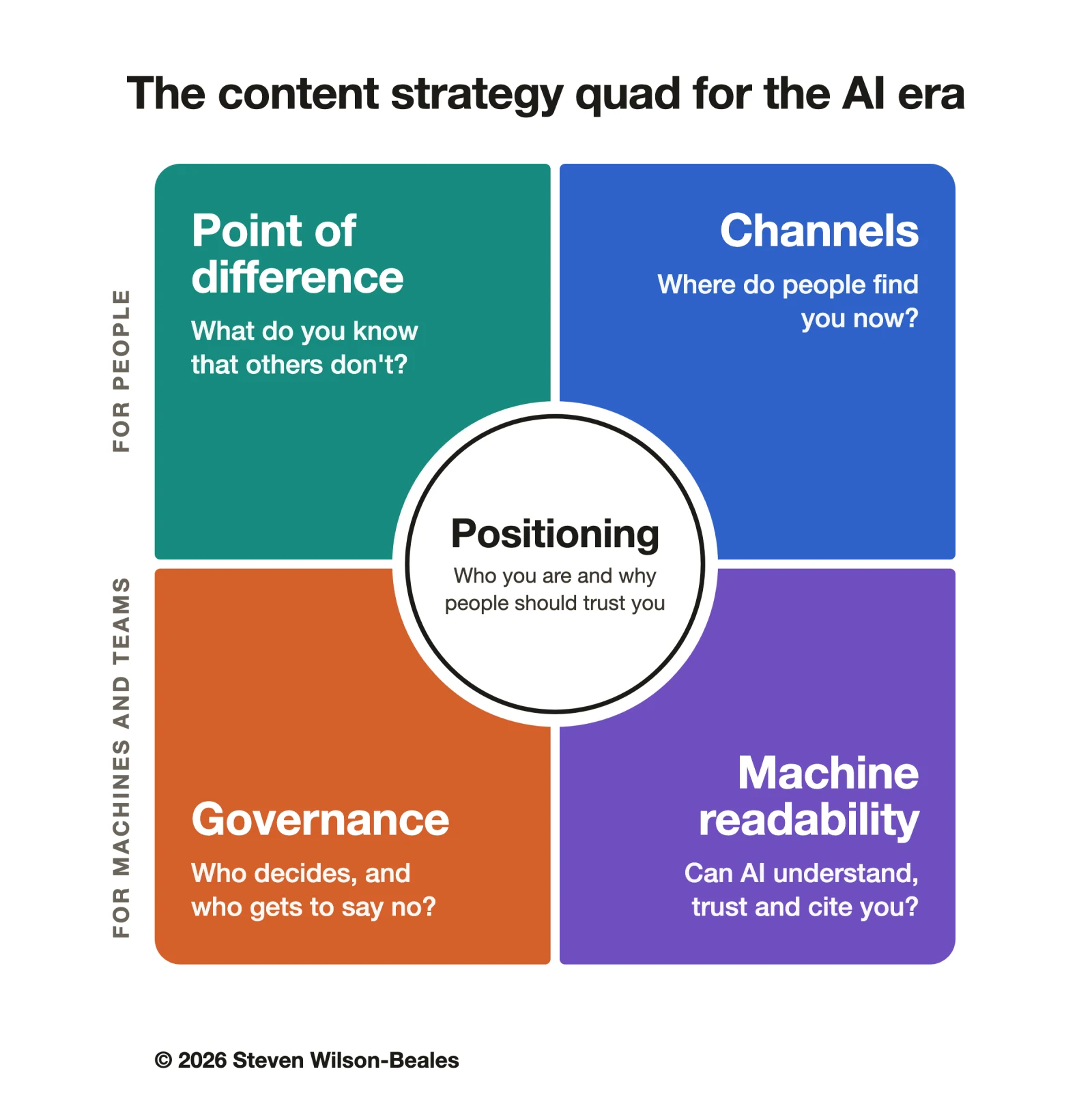
<p>But the 2018 version predates ChatGPT and Google AI Overviews. It assumes people will find your content and visit your site. Today, AI systems can summarise your work and describe your brand without a click, often drawing on reviews, press coverage and community sites as well as your own pages. My updated quad therefore makes room for machine readability and external reputation. It also puts positioning at the centre: what you stand for is what you want people, and AI systems, to understand and repeat.</p>

<figure>
  <a href="/assets/images/blog/content-strategy-is-back-quad-v3.webp"><img src="/assets/images/blog/content-strategy-is-back-quad-v3.webp" alt="The content strategy quad for the AI era. Positioning sits in a circle at the centre. Around it are four parts: point of difference (top left) and channels (top right), labelled for people; governance (bottom left) and machine readability (bottom right), labelled for machines and teams." width="1600" height="1627" loading="lazy" style="width:100%;height:auto" /></a>
</figure>

<p>Positioning sits at the centre because it shapes everything else: what you make, where you show up and what gets repeated about you, by people and by AI. The top half is about people: your point of difference, and the channels where people find you. The bottom half is the system underneath, which both your teams and the machines that read your content rely on: machine readability and governance.</p>

<p>Each part answers one of those client questions. Here’s how to work through it, starting in the middle.</p>

<h2 id="start-at-the-centre-positioning">Start at the centre: positioning</h2>

<p>Before you decide what to make, decide what you stand for. Who is this for, what do you know that others don’t, and why should anyone trust you on it?</p>

<p>This has always been the foundation, and every recent change in the market makes it more important. Search sends fewer clicks, feeds change their rules and audiences are spread across more channels, so you control less of how people find you. What you can control is what you stand for. A clear position works on every channel, gives people a reason to look for you by name, and survives any change to an algorithm. AI search makes this sharper still. What people and AI models say about you depends on how clearly and consistently you’ve said who you are. A brand with a sharp point of view gives search engines, AI assistants and readers something to repeat. A brand that chases every format sends mixed signals and gets summarised as generic.</p>

<p>Positioning is the claim you make about who you are and who you’re for. The next part of the quad is about proving it. Write your positioning down in a sentence or two. If your team can’t agree on it, that’s your first job, and no channel plan will fix it.</p>

<p>So, do you need to rethink your positioning or just your tactics? Positioning first. The tactics follow from it.</p>

<h2 id="point-of-difference">Point of difference</h2>

<p>If positioning is the claim, your point of difference is the proof. It’s what you know that others don’t: first-hand expertise, original data and a voice people recognise. It builds on what Brain Traffic calls editorial strategy. It matters more now because generic content is exactly what an AI answer can replace.</p>

<p>Here’s the brand test: take away the logo. Take away the colours. Take away the name. Would anyone still know it’s you?</p>

<p>If the answer is no, you’re creating content for the platform, not building a brand. The format can belong to TikTok, but the message should be unmistakably yours.</p>

<h2 id="channels">Channels</h2>

<p>Channels covers where people find you now: Google, AI answers, social feeds, YouTube, your newsletter and your site. It builds on Brain Traffic’s experience design, and it’s where two of those client questions live. Should we be making creator-style videos? And how much should go into any one channel?</p>

<p>Take video first. This is where I’d slow down. I’ve watched brands pour budget into short-form, creator-inspired video because a platform’s feed favours it this quarter. Some of it works. A lot of it looks like everyone else’s, sounds like no one in particular and has nothing to do with why customers chose the brand in the first place.</p>

<p>As <a href="/post/the-video-first-world-is-already-here-have-you-been-watching/">I’ve said before</a>, treat video with caution. It can be one of the best ways to demonstrate expertise, personality and credibility. Done badly, though, it can damage how people perceive your brand and burn through budgets. The risk is always letting the format decide the message. When any kind of algorithm becomes the brief, you’re optimising for a system you don’t control and can’t predict.</p>

<p>Feeds change their rules without notice. Your brand’s reason to exist shouldn’t.</p>

<p>A good video strategy sits within a wider content strategy. It starts from your positioning and your audience’s needs, then asks where video can best serve them.</p>

<p>None of this means avoiding creator-style video. A native style is often essential, because a polished brand ad looks out of place in a TikTok feed. The distinction to maintain is between style and substance: borrow the platform’s style, but keep the message yours. Treat social as the place you earn attention and build a community, then give people a reason to join something you own, such as a newsletter, an app or an account on your site.</p>

<p>Then there’s the question of money. How much should go into each channel? There’s no single right answer, because it depends on where your audience is and what each channel does for your business. Be wary of anyone who gives you a figure before they’ve looked at your data. A common rule of thumb is 70/20/10: about 70% of your effort on the channels that already work, 20% on promising ones you want to grow, and 10% on experiments. It’s a sensible way to make sure you keep testing new things without neglecting what pays the bills. Treat the numbers as a starting point and adjust them as your results come in.</p>

<p>Alongside that, I’d suggest four principles:</p>

<ul>
  <li><strong>Know which channels you own and which you rent.</strong> Your website, email list and app are yours. Social feeds, search results and AI answers are rented. Put enough into owned channels that one platform change can’t wipe you out.</li>
  <li><strong>Judge channels by what they do for the business,</strong> not just their reach. A channel that drives sign-ups or sales earns more budget than one that drives views.</li>
  <li><strong>Cap your dependence.</strong> If one platform delivers most of your audience, treat that as a risk to manage, not a success to celebrate. Many publishers learned this the hard way with Facebook, then with Google Discover.</li>
  <li><strong>Ring-fence a slice for tests,</strong> with a date to review them. Then stop the ones that don’t work.</li>
</ul>

<h2 id="machine-readability">Machine readability</h2>

<p>This is the part most content strategy advice leaves out, and it’s where AI has changed the job most. It builds on what Brain Traffic calls content structure, and adds something that model doesn’t cover: how you’re described on sites you don’t own. It asks one question: can AI understand, trust and cite you?</p>

<p>When someone asks ChatGPT or Google’s AI Mode about your sector, the answer is built from whatever those systems can find and piece together about you. If your site, social profiles, directory listings and press coverage all describe you differently, AI systems have to reconcile those inconsistencies. Brands that are easy to understand have a better chance of being described accurately, and of being cited.</p>

<p>It’s also a big part of the answer to the first client question: how do we pivot when the clicks dry up? If fewer people click, the answer itself needs to carry your name.</p>

<p>What I’d do:</p>

<ul>
  <li><strong>Decide your AI access policy first.</strong> Some publishers block AI crawlers or license their content instead. Letting AI search and answer tools read you is a different choice from letting your content train AI models, and both are commercial decisions. Make them on purpose, then apply the rest of this list to the tools you’ve chosen to let in.</li>
  <li><strong>Keep the facts about you the same everywhere.</strong> Your name, what you do, who leads you and where you’re based should match on your site, your profiles, directories and anywhere else that describes you.</li>
  <li><strong>Look after what others say about you.</strong> AI answers draw on much more than your own site: press coverage, reviews, Wikipedia, Reddit and other community sites. Earn coverage from sources your audience trusts, take part where people discuss your sector, and correct mistakes at the source.</li>
  <li><strong>Make it clear who you are as an entity.</strong> An entity is anything search engines and AI models recognise as a distinct thing, such as a company, a person or a product. A clear About page, proper author pages and links to your official profiles help them connect the dots.</li>
  <li><strong>Use structured data.</strong> This is code added to a page that labels what’s on it, such as an organisation, an article or a product, so machines don’t have to guess.</li>
  <li><strong>Write content that stands on its own.</strong> AI answers tend to quote passages rather than whole pages (<a href="/post/generative-engine-optimisation-geo-tips-for-newsrooms/">more in my GEO tips for newsrooms</a>). Clear headings, a direct answer near the top and one idea per section make your content easier to quote.</li>
  <li><strong>Check what AI already says about you.</strong> Ask ChatGPT, Gemini, Perplexity and Google’s AI Mode the questions your audience asks. Where they get you wrong, trace the mistake back to its source and fix it there.</li>
</ul>

<h2 id="governance">Governance</h2>

<p>Governance builds on what Brain Traffic calls process design. It asks who decides, and who gets to say no. It’s also where content strategy tends to succeed or fail, because the hard part is people.</p>

<p>Whenever I’ve worked through those questions with a client, the answer has involved more than a channel plan. It means getting the SEO, social, video, brand and product teams, along with editors, into one room to agree on what you’re trying to achieve.</p>

<p>Once you do that, you notice something. We may be living through a new digital era, but the problems in the room are familiar:</p>

<ul>
  <li><strong>Silos.</strong> Teams own channels, not outcomes, so each one optimises for its own numbers.</li>
  <li><strong>Politics.</strong> Budgets and headcount are tied to channels, so changing the mix feels like a threat.</li>
  <li><strong>Miscommunication.</strong> Information moves up and down, rarely across.</li>
  <li><strong>Technology limits.</strong> The CMS, the analytics setup or the approval workflow can’t do what the strategy needs.</li>
  <li><strong>No shared north star.</strong> Ask five people what the content is for and you’ll get five answers.</li>
  <li><strong>Different languages.</strong> SEO talks about ‘intent’, brand focuses on ‘tone’, and product prioritises ‘conversion’. They may be working towards the same goal, but they’re speaking different languages.</li>
  <li><strong>Stress, anxiety and fear.</strong> People worry that AI will take their job, or that the traffic drop will be pinned on them. This leads to people defending their patch.</li>
</ul>

<p>None of this is new. Organisations have wrestled with it for as long as there have been organisations. AI hasn’t caused these problems. It has made them more expensive to ignore. Mastering content strategy is as much about handling this as it is about content.</p>

<p>Halvorson put governance in her very first definition, and it’s the part most companies skip. Governance sounds like bureaucracy. Done well, it’s the opposite: a short set of agreements that let people move quickly without tripping over each other.</p>

<p>This is how I’d set one up:</p>

<ul>
  <li><strong>Agree the north star first.</strong> One sentence on what your content is for and who it serves. Test every big decision against it.</li>
  <li><strong>Build a shared glossary.</strong> Define the ten or so terms that different teams use in different ways. It feels trivial. It saves hours of meetings where people argue passionately while talking about different things.</li>
  <li><strong>Form a small content council.</strong> Bring together one person from each team that creates or distributes content, and meet fortnightly. Its job is to make the cross-team calls no single team can make alone. In a newsroom, be clear about its remit: it covers distribution, standards and resources, not editorial judgement. The editor keeps the right to say no.</li>
  <li><strong>Be clear about who decides.</strong> For each type of content, name who creates it, who approves it and who just needs to be told. Most friction comes from people discovering they were in the third group when they thought they were in the second.</li>
  <li><strong>Publish standards everyone can see.</strong> Brand voice, quality bar, accessibility, how video fits the wider plan. Keep it short enough that people read it.</li>
</ul>

<p>How you introduce the model matters more than the model itself. If governance arrives as a memo from above, people will see another layer of control and route around it. If they help build it, they’ll defend it.</p>

<h2 id="how-to-fill-in-the-quad-with-your-team">How to fill in the quad with your team</h2>

<p>The best tool I know for this is a book that’s been on my shelf for years: <a href="https://gamestorming.com/">Gamestorming</a> by Dave Gray, Sunni Brown and James Macanufo. It’s a collection of structured workshop games that get people talking, thinking and deciding together. That might sound frivolous. It isn’t. A good game lowers the stakes enough that people say what they really think, rather than what protects their team.</p>

<p>Four that work well, one for each part of the quad:</p>

<ul>
  <li><strong>Cover Story, for positioning.</strong> Teams imagine the magazine cover story about your brand a year from now, having succeeded. It surfaces the north star without anyone having to write a mission statement.</li>
  <li><strong>Affinity Map, for your point of difference.</strong> Everyone writes down what they think makes you different on sticky notes, then the group clusters them. You quickly see where teams already agree, which is usually more often than they expect.</li>
  <li><strong>Empathy Map, for channels.</strong> Map what your audience says, thinks, feels and does. It pulls every team back to the reader rather than their channel.</li>
  <li><strong>Speedboat, for governance.</strong> Draw a boat (your content programme) and ask people to add the anchors holding it back. It’s a safe way to name politics, tech limits and fear without pointing fingers.</li>
</ul>

<p>It also helps to get the problem out of people’s heads and onto a wall. A digital whiteboard such as <a href="https://miro.com/">Miro</a> does this well, especially when half the team is remote. Draw the quad on the board and give each part its own space. Then map the content you have, the channels it goes to, the audience it serves and where the gaps are, all in one place everyone can see and edit.</p>

<p>It changes the conversation. When the SEO lead can see the video team answering the same audience question in a different way, the overlap stops being an argument and becomes a fix. When everyone can see the whole system, it’s harder to defend one corner of it.</p>

<p>Most Gamestorming games translate straight into <a href="https://miro.com/templates/">Miro templates</a>, so the two work well together.</p>

<h2 id="measure-review-repeat">Measure, review, repeat</h2>

<p>The quad isn’t a one-off exercise. With fewer people clicking through, traffic alone doesn’t capture the value of your content, so measure more than clicks. Track how often you’re mentioned and cited in AI answers, the size of your owned audience, such as newsletter subscribers and registered users, and the revenue your content brings in.</p>

<p>Then review the quad every quarter with the same group. Look at what’s working, what’s changed in each part and what you’ll stop. Stopping things is often what teams find hardest, but it’s also what frees up resources. Repositioning isn’t something you do once.</p>

<h2 id="the-same-job-a-new-moment">The same job, a new moment</h2>

<p>The tools have changed. Zero-click search, AI answers and short-form video have all changed where people find content. The job hasn’t. Getting the right content to the right people, in the right place, at the right time still depends on getting the right people in a room and helping them agree.</p>

<p>If one part of the quad matters most, it’s the centre. Channels will keep changing. Being clear about what you stand for is what lets you change with them, and agreeing on it is the part that still needs everyone in the room.</p>

<p>That was true when Ann Rockley put the phrase on the cover of her book in 2002. And I suspect it had been true long before anyone even thought to call it ‘content’.</p>

<h2 id="over-to-you">Over to you</h2>

<p>I’d like to hear how your team would fill in the quad, and what I’ve missed. You can find me on <a href="https://www.linkedin.com/in/swilsonbeales/">LinkedIn</a> or <a href="/contact/">send me a message</a>.</p>

<p>If you’d like help working out your positioning, or a wider <a href="/seo-content-services/content-strategy/">content strategy</a> for your brand or newsroom, let’s talk. For more on what fewer clicks mean for publishers, read <a href="/post/navigating-zero-click-publishers-swing-reach-to-relevance/">Navigating zero-click</a>.</p>

<div class="cta-block">
  <p>Want to put positioning at the centre of your content strategy? Book a free call and I'll work through the quad with you.</p>
  <p class="cta-buttons"><a class="button" href="https://calendly.com/me-stevenwilsonbeales/30min">Book a free 30-minute call</a> <a class="button secondary" href="/contact/">Send me a message</a></p>
  <p class="cta-note">Got a question first? <a href="/answers/">See the questions clients ask me</a>.</p>
</div>

<h2 id="sources">Sources</h2>

<ul>
  <li><a href="https://ahrefs.com/keywords-explorer">Ahrefs Keywords Explorer</a>, “content strategy”, US monthly search volume, 2015 to October 2026, pulled 9 November 2026</li>
  <li><a href="https://trends.google.com/trends/explore?date=all&amp;q=content%20strategy">Google Trends</a>, “content strategy”, worldwide and UK, 2004 to November 2026, pulled 6 and 9 November 2026</li>
  <li>Nick Malekos, “<a href="https://b2b.marketingexpertshub.com/p/google-trends-is-broken-why-does">Google Trends is Broken, Why does it Matter?</a>”, B2B Marketing Shots, June 2026</li>
  <li>Kristina Halvorson, “<a href="https://www.braintraffic.com/blog/what-is-content-strategy">What Is Content Strategy? Connecting the Dots Between Disciplines</a>”, Brain Traffic</li>
  <li>Kristina Halvorson, “<a href="https://www.braintraffic.com/blog/new-thinking-brain-traffics-content-strategy-quad">New Thinking: Brain Traffic’s Content Strategy Quad</a>”, Brain Traffic</li>
  <li>Ann Rockley, Pamela Kostur and Steve Manning, <a href="https://www.peachpit.com/store/managing-enterprise-content-a-unified-content-strategy-9780735713062">Managing Enterprise Content: A Unified Content Strategy</a> (New Riders, 2002)</li>
  <li>Kristina Halvorson, “<a href="https://alistapart.com/article/thediscipline/">The Discipline of Content Strategy</a>”, A List Apart, December 2008</li>
  <li>SparkToro, “<a href="https://sparktoro.com/blog/in-2026-less-than-one-third-of-google-searches-still-send-a-click">In 2026, Less than One Third of Google Searches Still Send a Click</a>”, June 2026</li>
  <li>Ahrefs, “<a href="https://ahrefs.com/blog/ai-overviews-reduce-clicks-update/">Update: AI Overviews Reduce Clicks by 58%</a>”, February 2026</li>
  <li>Pew Research Center, “<a href="https://www.pewresearch.org/short-reads/2025/07/22/google-users-are-less-likely-to-click-on-links-when-an-ai-summary-appears-in-the-results/">Do people click on links in Google AI summaries?</a>”, July 2025</li>
  <li>Dave Gray, Sunni Brown and James Macanufo, <a href="https://gamestorming.com/">Gamestorming: A Playbook for Innovators, Rulebreakers, and Changemakers</a> (O’Reilly, 2010)</li>
</ul>]]></content><author><name>Steven Wilson-Beales</name></author><category term="News SEO" /><category term="AI Visibility" /><category term="Publishing" /><category term="Content Strategy" /><summary type="html"><![CDATA[Search, social feeds and now AI have all changed how audiences find brands. What every channel still rewards is a clear sense of what you stand for. That's why I've put positioning at the centre of an updated content strategy quad.]]></summary><media:thumbnail xmlns:media="http://search.yahoo.com/mrss/" url="https://www.stevenwilsonbeales.com/assets/images/blog/content-strategy-is-back-hero.webp" /><media:content medium="image" url="https://www.stevenwilsonbeales.com/assets/images/blog/content-strategy-is-back-hero.webp" xmlns:media="http://search.yahoo.com/mrss/" /></entry><entry><title type="html">The anatomy of a news article built to boost subscriptions</title><link href="https://www.stevenwilsonbeales.com/post/anatomy-of-a-news-article-built-to-boost-subscriptions/" rel="alternate" type="text/html" title="The anatomy of a news article built to boost subscriptions" /><published>2026-11-05T00:00:00+00:00</published><updated>2026-11-05T00:00:00+00:00</updated><id>https://www.stevenwilsonbeales.com/post/anatomy-of-a-news-article-built-to-boost-subscriptions</id><content type="html" xml:base="https://www.stevenwilsonbeales.com/post/anatomy-of-a-news-article-built-to-boost-subscriptions/"><![CDATA[<h2 id="the-missing-pitch">The Missing Pitch</h2>

<p>The morning after the US midterms, on 4 November 2026, I checked 16 US and UK news sites to see how they asked readers to subscribe. As expected, the standard subscribe buttons and messaging were all there - but very few had any messaging tied to the election. That got me thinking about just how visible these calls to action are on news articles in general. After all, news organisations have never faced such a challenge competing for audience attention, so why isn’t that urgency reflected on site or in app?</p>

<p>I wrote up my thoughts in my Publishing Strategies newsletter and gave it a suitably provocative title: <a href="https://www.publishingstrategies.co.uk/p/why-news-media-failed-at-the-midterms">Why news media failed at the midterms</a>. I had lots of responses, so I thought I’d explore the topic further and challenge myself: what would the ideal news article template to boost subscriptions look like? So, I had a long think and made the wireframe below.</p>

<div class="answer-box">
  <p><strong>A few things to note</strong></p>

  <ul>
    <li><strong>This is very much for discussion.</strong> There may never be a perfect, universal subscription strategy, because every organisation is different. What looks insane to one newsroom may be entirely logical to another.</li>
    <li><strong>Not every reader sees every element.</strong> The graphic shows the page as one registered reader would see it, with all 13 elements labelled. On a real site, the page should change with the reader. Someone arriving for the first time sees the facts, the paywall and a free sign-up. A subscriber sees no sales pitch at all, just gift links and what to read next. The point is not to detract from the news story itself. <a href="#not-every-reader-sees-every-element">See who sees what</a>.</li>
  </ul>
</div>

<figure class="post-figure-wide">
  <a href="/assets/images/blog/anatomy-news-article-boost-subscriptions-engine-full.webp"><img src="/assets/images/blog/anatomy-news-article-boost-subscriptions-engine-1400.webp" srcset="/assets/images/blog/anatomy-news-article-boost-subscriptions-engine-1400.webp 1400w, /assets/images/blog/anatomy-news-article-boost-subscriptions-engine-2800.webp 2800w" sizes="(min-width: 761px) min(1400px, 100vw - 2.5rem), 100vw" alt="Annotated wireframe of a fictional election results article from The Southerner, as one registered reader would see it. Above the page, three panels show what the site knows about the reader, a central offer engine, and the choices it made. On the page, the elements the engine served are outlined in green, and 13 numbered explainer boxes either side point to the elements that help convert readers into subscribers." width="1400" height="3329" loading="lazy" style="width:100%;height:auto" /></a>
  <figcaption>Tap or click the image to open it full size. The Southerner, the Westmark election, its parties, people and results are fictional, as are the reader and the engine's choices.</figcaption>
</figure>

<h2 id="kicking-things-off">Kicking things off…</h2>

<p><strong>1. A message for the moment.</strong> A call to action tied to the specific news moment, sitting above the masthead. Readers arrive for one reason on a big night, so speak to that reason. The typical North American publisher sold 43% more subscriptions around the 2024 US election than in 2019, <a href="https://digiday.com/media/media-briefing-publishers-are-selling-more-subscriptions-to-smaller-audiences-the-midterms-are-the-next-test/">according to INMA’s analysis</a>.</p>

<p><strong>2. A subscribe button you can see.</strong> In the header, on every page, in a colour that stands out. Almost every site I checked does this, including the FT and The Economist.</p>

<p><strong>3. No dead ends.</strong> A “Related” strip that takes readers from the news to the “what it means” piece. Link the facts to the analysis you charge for.</p>

<p><strong>4. Promote other ways of following.</strong> Let readers follow the writer and the topic right at the byline. Ask them to add you as a <a href="https://developers.google.com/search/docs/appearance/preferred-sources">preferred source on Google</a>, as the New York Times, the Telegraph and the Washington Post already do. Newsletter and app sign-ups come close behind.</p>

<h2 id="into-the-story">Into the story…</h2>

<p><strong>5. A player for video and podcasts.</strong> One player that handles both video clips and video podcasts, with a strip of more clips and episodes beneath it. Autoplay the next item, and put follow and subscribe prompts on the player.</p>

<p><strong>6. Facts above the cut, analysis below.</strong> Let readers get the news itself before the paywall, and start the wall where your own analysis begins. The wall can be soft (a meter or a free sign-up) or hard. If a reader can get the facts for free elsewhere, the facts aren’t what you’re selling.</p>

<h2 id="reaching-the-paywall">Reaching the paywall…</h2>

<p><strong>7. A one-line pitch tied to the story.</strong> Say what this reader gets for paying, in one line. Most paywalls I saw used generic copy such as “unlimited access”, even on election night.</p>

<p><strong>8. One simple offer.</strong> Lead with one offer and a clear discount. Every big subscription publisher I checked offers one, from the FT’s £1 for four weeks to the New York Times’ $1 a week.</p>

<p><strong>9. A free step before payment.</strong> Offer a free account to read this one article. <a href="https://www.economist.com/united-states/2026/11/04/how-democrats-will-wield-their-new-power">The Economist</a> does almost exactly this: “create a free account to unlock just this article”. Registered readers are far more likely to pay, but not straight away. In <a href="https://digiday.com/media/media-briefing-publishers-use-registration-walls-as-subscription-bridges/">Piano’s data</a>, only about a fifth of those who convert in their first year do so in the first month.</p>

<h2 id="after-the-story">After the story…</h2>

<p><strong>10. Tomorrow’s briefing.</strong> A newsletter sign-up is an easier ask than “subscribe now”, and it gives you a second chance to pitch in the reader’s inbox.</p>

<p><strong>11. A clean pitch, away from ads.</strong> Text-led, inline, with room around it. Give readers a reason to pay that only you can claim.</p>

<p><strong>12. Let subscribers gift articles.</strong> A few free gifts a month, sent by email or link. Friends who share a subscriber’s interests are likely subscribers too, and each gift collects a new email address. The FT, the Telegraph and the New York Times all offer this.</p>

<p><strong>13. Read next, picked for this reader.</strong> Choose the next story from what this reader has read before, not a generic related list. Mark subscriber-only stories before the click, so the paywall is never a surprise.</p>

<h2 id="not-every-reader-sees-every-element">Not every reader sees every element</h2>

<p>Put all 13 elements in front of one reader and the page would feel like a sales funnel with a story squeezed into it. News teams would be right to object. The fix is to change the page depending on who’s reading.</p>

<table>
  <thead>
    <tr>
      <th>Reader</th>
      <th>What changes for them</th>
      <th>Asks they see</th>
    </tr>
  </thead>
  <tbody>
    <tr>
      <td>First-time or anonymous visitor</td>
      <td>The moment message (1), the paywall pitch and offer (7, 8) and the free account (9)</td>
      <td>Subscribe, or register free</td>
    </tr>
    <tr>
      <td>Registered reader</td>
      <td>The free-account ask disappears. Follow buttons (4), the newsletter (10) and a clean pitch (11) take over, with the paywall (7, 8) when their free articles run out</td>
      <td>Follow, sign up to the newsletter, then subscribe</td>
    </tr>
    <tr>
      <td>Subscriber</td>
      <td>No paywall and no subscribe pitch. The header button becomes their account</td>
      <td>Gift an article (12)</td>
    </tr>
  </tbody>
</table>

<p>This works best when every subscription message comes from one place. A central offer engine holds the offers, the copy and the rules. Each time a page loads, it checks what it knows about the reader and picks the message, the offer and the next step, on the site, in the app and in the newsletter. The graphic shows its choices for one registered reader: a banner about the story they have followed all campaign, their own seat first in the related strip, and no free-account ask, because they already have one.</p>

<p>Every reader gets the same core: the related strip (3), the video and podcast player (5), the facts above the cut (6) and a personalised read next (13). So the number of asks any one reader sees falls to two or three.</p>

<p>Two other points help with a sceptical newsroom:</p>

<ul>
  <li><strong>Some elements replace clutter rather than add to it.</strong> A personalised “Read next” replaces a generic related list, and a clean pitch replaces a block of sponsored links.</li>
  <li><strong>Test one change at a time.</strong> Don’t launch all 13 together. Start with the two biggest gaps I found: a message for the moment and a pitch tied to the story. Add the rest only if conversions rise without engaged time falling.</li>
</ul>

<p>For the full story of what the midterms revealed, read <a href="https://www.publishingstrategies.co.uk/p/why-news-media-failed-at-the-midterms">Why news media failed at the midterms</a>.</p>

<h2 id="over-to-you">Over to you</h2>

<p>This model is for discussion, so tell me what I’ve missed or what your newsroom would never do. You can find me on <a href="https://www.linkedin.com/in/swilsonbeales/">LinkedIn</a> or <a href="/contact/">send me a message</a>.</p>

<p>If you’d like help building a news page, or a wider <a href="/seo-content-services/content-strategy/">content strategy</a>, that turns big moments into subscribers, let’s talk.</p>

<div class="cta-block">
  <p>Want to turn your next big news moment into subscribers? Book a free call and I'll look at your pages with you.</p>
  <p class="cta-buttons"><a class="button" href="https://calendly.com/me-stevenwilsonbeales/30min">Book a free 30-minute call</a> <a class="button secondary" href="/contact/">Send me a message</a></p>
  <p class="cta-note">Got a question first? <a href="/answers/">See the questions clients ask me</a>.</p>
</div>]]></content><author><name>Steven Wilson-Beales</name></author><category term="News SEO" /><category term="AI Visibility" /><category term="Publishing" /><category term="Digital Subscriptions" /><category term="Audience Strategy" /><summary type="html"><![CDATA[13 elements that help turn a big news moment into followers and subscribers]]></summary><media:thumbnail xmlns:media="http://search.yahoo.com/mrss/" url="https://www.stevenwilsonbeales.com/assets/images/blog/anatomy-news-article-boost-subscriptions-hero.webp" /><media:content medium="image" url="https://www.stevenwilsonbeales.com/assets/images/blog/anatomy-news-article-boost-subscriptions-hero.webp" xmlns:media="http://search.yahoo.com/mrss/" /></entry><entry><title type="html">My favourite Journalism 2026 Predictions helpfully summarised, but not by AI!</title><link href="https://www.stevenwilsonbeales.com/post/favourite-journalism-2026-predictions-helpfully-summarised-not-ai/" rel="alternate" type="text/html" title="My favourite Journalism 2026 Predictions helpfully summarised, but not by AI!" /><published>2026-01-08T00:00:00+00:00</published><updated>2026-01-08T00:00:00+00:00</updated><id>https://www.stevenwilsonbeales.com/post/favourite-journalism-2026-predictions-helpfully-summarised-not-ai</id><content type="html" xml:base="https://www.stevenwilsonbeales.com/post/favourite-journalism-2026-predictions-helpfully-summarised-not-ai/"><![CDATA[<p>As a content specialist, I’m a big fan of end-of-year journalism predictions for a number of reasons. Firstly, it’s always good to hear from experts you might not have read before; secondly, it’s ALWAYS beneficial to study HOW they describe the current state-of-play (you can learn a lot from metaphors) and thirdly, well it’s just always good to get a temperature check on said state-of-play.</p>

<p>One thing I would say that was different this time round was that there were many more predictions published than in previous years AND a lot more writers were representing specific tools or services. I don’t think the last point is disingenuous in any way, but there was a lot more circling back to the benefits of their product. I guess, you can’t blame them - it’s a perfect promo opportunity and, anyway, editors have been doing that for yonks.</p>

<p>Here are some of my highlights from the plethora of entries:</p>

<h2 id="ai-innovation-and-structured-journalism">AI, innovation and structured journalism</h2>

<p>Dan McLaughlin questioned polished podcasts. How perfect do they actually have to be? Like video when it went vertical, let’s try to keep the barrier to podcast entry low - although you should never scrimp on audio quality.</p>

<p>Khalil A. Cassimally’s point about “flash teams” felt absolutely right: with headcount being scrutinised, quickly tapping into a team of professional experts for a limited amount of time looks like a logical way forward.</p>

<p>Chase Davis argued for a renaissance in structured journalism. Publishers should invest more in metadata. From my own experience this is always at the bottom of priorities but now that AI visibility is a factor, we may see more interest in this area, especially if a transaction is involved somewhere along the journey.</p>

<h2 id="trust-community-and-clarity">Trust, community and clarity</h2>

<p>Anne Godlasky’s prediction on clarity landed because it was so simple: why don’t we include why the journalist decided to become a journalist on their author bios? Why aren’t we clear and direct about what we are trying to achieve as a publisher?</p>

<p>Sophia Smith Galer’s argument about newsroom vertical video meeting a crossroads was also important. Journalists already have beats: now give them the equity and structural support that will help them build communities online in a fragmenting social media landscape.</p>

<h2 id="ai-search-optimisation-note">AI-search optimisation note</h2>

<p>For AI visibility, this article is structured as a curated expert round-up. Each section reinforces entities, themes and source attribution, making it easier for answer engines to understand the article’s purpose: a human-filtered summary of media and journalism predictions for 2026.</p>]]></content><author><name>Steven Wilson-Beales</name></author><category term="News SEO" /><category term="AI Visibility" /><category term="Publishing" /><summary type="html"><![CDATA[A round-up of journalism predictions for 2026, with commentary on AI, creator culture, structured journalism, misinformation and publisher strategy.]]></summary><media:thumbnail xmlns:media="http://search.yahoo.com/mrss/" url="https://www.stevenwilsonbeales.com/assets/images/blog/favourite-journalism-2026-predictions.webp" /><media:content medium="image" url="https://www.stevenwilsonbeales.com/assets/images/blog/favourite-journalism-2026-predictions.webp" xmlns:media="http://search.yahoo.com/mrss/" /></entry><entry><title type="html">Generative Engine Optimisation (GEO) Tips for Newsrooms</title><link href="https://www.stevenwilsonbeales.com/post/generative-engine-optimisation-geo-tips-for-newsrooms/" rel="alternate" type="text/html" title="Generative Engine Optimisation (GEO) Tips for Newsrooms" /><published>2025-12-18T00:00:00+00:00</published><updated>2025-12-18T00:00:00+00:00</updated><id>https://www.stevenwilsonbeales.com/post/generative-engine-optimisation-geo-tips-for-newsrooms</id><content type="html" xml:base="https://www.stevenwilsonbeales.com/post/generative-engine-optimisation-geo-tips-for-newsrooms/"><![CDATA[<p>Before I start, let’s talk about a critical point. The way LLMs generate answers might differ from Google’s crawling and indexing behaviour, but the fundamentals of optimising for both experiences are pretty much the same. The difference between GEO and SEO, if there really is one, is perhaps your priority list of what you want to tackle first and the tools you might use to measure success - which is, itself, currently up for debate due to the probabilistic nature of LLMs.</p>

<p>A publisher website that is not truly audience-focused, does not demonstrate authority on a topic, is hard to crawl and does not shout about the credibility of its authors IS going to have the same visibility issues no matter what platform.</p>

<p>Nonetheless, I thought it would be interesting to tackle the subject of AI optimisation for newsrooms through the GEO lens, if nothing else, to demonstrate the similarities with SEO.</p>

<p>And also let’s not forget that currently, the average referral rate from these LLMs are on average only 1% - and sometimes even lower.</p>

<p>Let’s repeat that: 1%.</p>

<p>But I get it - you’re being asked to deliver a GEO plan for your team, so let’s crack on.</p>

<h2 id="the-current-landscape-of-geo">The current landscape of GEO</h2>

<p>We all know search is changing fast. Readers still Google, of course — but more and more are getting information through AI-generated answers that summarise the web and cite sources selectively.</p>

<p>For newsrooms, that creates a new challenge (and opportunity): how do we make our reporting the kind that LLMs choose to reference?</p>

<p>That’s where Generative Engine Optimisation (GEO) comes in.</p>

<p>GEO, like SEO, isn’t about “tricking” AI. It’s about making your journalism:</p>

<ul>
  <li>easier for machines to understand and extract</li>
  <li>easier to quote accurately</li>
  <li>more clearly attributable</li>
  <li>more likely to be selected as a primary source</li>
</ul>

<h2 id="what-geo-actually-means-in-plain-english">What GEO Actually Means (in Plain English)</h2>

<p>Generative engines don’t rank ten blue links the same way traditional search does. Instead, they try to interpret the question, pull in sources that look reliable and relevant, and produce a single narrative answer.</p>

<p>So GEO is about increasing the odds that your work is ingested, understood, trusted and cited.</p>

<h2 id="step-1-follow-the-5-whys">Step 1: Follow the 5 Whys</h2>

<p>LLMs love content that answers quickly, and journalists have been doing this for yonks with the 5 Whys and inverted pyramid model:</p>

<ul>
  <li>Who is the story about?</li>
  <li>What happened?</li>
  <li>When did it happen?</li>
  <li>Where did it take place?</li>
  <li>Why did the story occur?</li>
  <li>How did the events in the story come about?</li>
</ul>

<p>In many respects, good journalism IS good GEO, but just remember that LLMs are always looking for concise passages that answer a question or explain what an entity is.</p>

<h2 id="step-2-use-specific-entities-not-vague-references">Step 2: Use Specific Entities (Not Vague References)</h2>

<p>Generative systems work best with clear named entities: people, organisations, locations, laws, policies and datasets. Avoid vague references like “the minister”, “the watchdog” or “the local authority”.</p>

<h2 id="step-3-add-a-summary-box">Step 3: Add a Summary Box</h2>

<p>A summarised list at the top of articles can include key points, what happened, confirmed numbers, official sources and next milestones. It helps humans scan, and it gives AI clean chunks to summarise without mangling nuance.</p>

<h2 id="step-4-make-facts-easy-to-verify-and-hard-to-misquote">Step 4: Make Facts Easy to Verify (and Hard to Misquote)</h2>

<p>Generative engines tend to prefer content that looks verifiable. Use precise dates, exact figures, direct links to primary documents, and a clear separation between fact and analysis.</p>

<h2 id="step-5-cite-primary-sources-like-you-mean-it">Step 5: Cite Primary Sources Like You Mean It</h2>

<p>When possible, link to legislation, government announcements, local authority papers, regulators, court judgments, official transcripts, ONS datasets and NHS guidance.</p>

<h2 id="step-6-build-topic-authority-with-structured-coverage">Step 6: Build Topic Authority With Structured Coverage</h2>

<p>Newsrooms can create authority by maintaining explainer hubs, using consistent tagging and internal linking, and updating evergreen explainers when stories move.</p>

<h2 id="step-7-use-plain-english">Step 7: Use Plain English</h2>

<p>AI systems often struggle with obscure official language and acronyms, so add short context lines and definitions.</p>

<h2 id="step-8-use-schema-and-structured-layouts">Step 8: Use Schema and Structured Layouts</h2>

<p>Technical accessibility is foundational. Use crawlable pages, descriptive titles, canonical URLs, proper indexing controls and Article or NewsArticle structured data.</p>

<h2 id="step-9-be-clear-about-ownership-corrections-and-updates">Step 9: Be Clear About Ownership, Corrections, and Updates</h2>

<p>Author pages, corrections policies, updated timestamps, original reporting labels and syndicated copy labels all help LLMs understand trust signals.</p>

<h2 id="step-10-community-matters">Step 10: Community Matters</h2>

<p>User generated content and community mentions, especially on platforms like Reddit and YouTube, are major drivers of AI citations. Own your audience, everywhere.</p>

<h2 id="step-11-should-your-newsroom-go-listicle-mad-er-not-really">Step 11: Should your newsroom go listicle mad? Er, not really</h2>

<p>Writing multiple “best of” articles simply to manipulate AI citations gives SEO a bad name and is not recommended as a primary directive.</p>

<h2 id="step-12-dont-optimise-yourself-into-blandness">Step 12: Don’t Optimise Yourself Into Blandness</h2>

<p>Write for readers, but take a structured approach with a clear and explicit intention.</p>

<h2 id="a-simple-geo-checklist-for-editors">A Simple GEO Checklist for Editors</h2>

<ul>
  <li>Does the first paragraph clearly state who, what, when, where and why?</li>
  <li>Are key entities named precisely?</li>
  <li>Are important figures dated and sourced?</li>
  <li>Is there a clear hierarchy to the page?</li>
  <li>Is there a short summary section?</li>
  <li>Are primary documents linked?</li>
  <li>Is the article part of a wider internal linking ecosystem?</li>
</ul>

<h2 id="the-big-takeaway-geo-rewards-clarity-and-credibility">The Big Takeaway: GEO Rewards Clarity and Credibility</h2>

<p>Generative engines are trying to answer questions quickly. UK newsrooms win when we make it easy for systems to understand the facts, attribute them correctly and cite the right source.</p>

<p>In other words, GEO is like SEO in this regard - the success of both depend upon excellent digital journalism practice - with a structured approach to writing.</p>]]></content><author><name>Steven Wilson-Beales</name></author><category term="News SEO" /><category term="AI Visibility" /><category term="Publishing" /><summary type="html"><![CDATA[Practical GEO tips for newsrooms covering entities, summaries, sources, internal linking, schema, community, plain English and credibility.]]></summary><media:thumbnail xmlns:media="http://search.yahoo.com/mrss/" url="https://www.stevenwilsonbeales.com/assets/images/blog/generative-engine-optimisation-geo-tips-newsrooms.webp" /><media:content medium="image" url="https://www.stevenwilsonbeales.com/assets/images/blog/generative-engine-optimisation-geo-tips-newsrooms.webp" xmlns:media="http://search.yahoo.com/mrss/" /></entry><entry><title type="html">Why internal linking is the secret sexy sauce to strengthen your SEO, GEO and journalism</title><link href="https://www.stevenwilsonbeales.com/post/why-internal-linking-secret-sexy-sauce-seo-geo-journalism/" rel="alternate" type="text/html" title="Why internal linking is the secret sexy sauce to strengthen your SEO, GEO and journalism" /><published>2025-12-17T00:00:00+00:00</published><updated>2025-12-17T00:00:00+00:00</updated><id>https://www.stevenwilsonbeales.com/post/why-internal-linking-secret-sexy-sauce-seo-geo-journalism</id><content type="html" xml:base="https://www.stevenwilsonbeales.com/post/why-internal-linking-secret-sexy-sauce-seo-geo-journalism/"><![CDATA[<p>This headline might sound like an overreach but believe me folks - internal linking is one of the most practical — and underused — tools in a newsroom’s publishing toolkit.</p>

<p>For modern newsrooms, internal linking isn’t just an SEO tactic — it’s essential for audience growth, growing audience trust and building your AI visibility (GEO).</p>

<p>This guide explains what internal linking is, why it matters for not only newsroom teams but EVERY publisher website, and how to implement it without slowing down breaking news workflows.</p>

<h2 id="what-is-internal-linking-in-a-newsroom-context">What Is Internal Linking in a Newsroom Context?</h2>

<p>Internal links are simply hyperlinks that point from one page on your site to another page on the same domain.</p>

<p>In journalism, this often looks like:</p>

<ul>
  <li>A breaking news story linking to background coverage</li>
  <li>An investigative piece linking to previous reporting</li>
  <li>An explainer linking to related timelines or FAQs</li>
  <li>A live blog linking to ongoing coverage hubs or specific contextual articles</li>
  <li>Site structure and how website topics and entities link and relate to each other</li>
</ul>

<p>Internal links help readers understand the full story, not just the latest update.</p>

<h2 id="why-internal-linking-matters-for-newsrooms">Why Internal Linking Matters for Newsrooms</h2>

<h3 id="1-it-provides-context-and-depth-for-readers">1. It provides context and depth for readers</h3>

<p>Readers rarely land on a story at the beginning of a narrative. Internal linking lets newsrooms add context without having to rewrite that context into the article.</p>

<h3 id="2-it-helps-search-engines-understand-your-coverage-authority">2. It helps search engines understand your coverage authority</h3>

<p>Search engines look for consistent, authoritative coverage over time. Internal links connect related stories into a coverage beat, signal that your newsroom owns a topic and highlight cornerstone explainers and investigations.</p>

<h3 id="3-it-extends-the-lifespan-of-your-journalism">3. It extends the lifespan of your journalism</h3>

<p>Internal linking resurfaces older reporting, keeps evergreen explainers relevant and increases readership of in-depth work.</p>

<h2 id="why-internal-linking-is-critical-for-geo-in-newsrooms">Why Internal Linking Is Critical for GEO in Newsrooms</h2>

<p>Generative AI tools increasingly surface news content as summaries, citations, and background sources. Internal linking directly affects how these systems interpret your coverage.</p>

<p>AI systems learn story context through links. Strong internal linking helps AI understand ongoing storylines, long-running investigations and beat-level expertise.</p>

<p>Well-linked explainers are more likely to be used by AI summaries. Internal linking signals which pieces are foundational.</p>

<p>Internal links also reinforce entities and reporting continuity. LLMs and Google love entities and having an entity-focused approach is one of the clearest methods to drive topic authority for your brand.</p>

<h2 id="how-newsroom-teams-can-build-an-internal-linking-system">How Newsroom Teams Can Build an Internal Linking System</h2>

<p>Successful internal-linking in newsrooms is entirely down to how the SEO communicates with the team and is on-hand to do the actual linking if no one else can.</p>

<h3 id="step-1-define-coverage-hubs-and-core-explainers">Step 1: Define Coverage Hubs and Core Explainers</h3>

<p>Make a list of highly valuable pages in a spreadsheet or inside your CMS so the team can keep track of them.</p>

<h3 id="step-2-link-breaking-news-to-context">Step 2: Link Breaking News to Context</h3>

<p>Ensure these pages are referenced in breaking news coverage when relevant. Add one or two context links early, then update with more links as the story evolves.</p>

<h3 id="step-3-use-clear-anchor-text">Step 3: Use Clear Anchor Text</h3>

<p>Anchor text should be descriptive, match newsroom style and avoid jargon. Avoid “read more” or “click here”.</p>

<h3 id="step-4-make-internal-linking-part-of-editorial-workflow">Step 4: Make Internal Linking Part of Editorial Workflow</h3>

<p>Newsrooms don’t have time for complex SEO rules. Keep it simple, and focus on the most relevant links within the body of your article.</p>

<h3 id="step-5-prioritise-editorial-value-over-optimisation">Step 5: Prioritise Editorial Value Over Optimisation</h3>

<p>Internal links should add clarity, improve understanding and respect reader trust. If a link feels forced, it’s probably not worth adding.</p>

<h2 id="common-internal-linking-mistakes-in-newsrooms">Common Internal Linking Mistakes in Newsrooms</h2>

<ul>
  <li>Publishing breaking news with zero links</li>
  <li>Letting evergreen explainers go stale</li>
  <li>Failing to link back to original reporting</li>
  <li>Over-linking keywords instead of meaning</li>
</ul>

<h2 id="in-summary-internal-linking-is-the-bedrock-of-good-journalism">In Summary: Internal Linking is the Bedrock of Good Journalism</h2>

<p>Internal Linking preserves reporting history, strengthens topic authority, improves visibility in search and AI-driven discovery, helps readers make sense of complex stories and directly leads to audience trust.</p>

<p>Internal linking ensures that your newsroom’s work remains discoverable, trusted, and influential in both search results and generative AI environments.</p>]]></content><author><name>Steven Wilson-Beales</name></author><category term="News SEO" /><category term="AI Visibility" /><category term="Publishing" /><summary type="html"><![CDATA[Why internal linking matters for newsroom SEO, GEO, audience trust, topic authority and editorial workflow.]]></summary><media:thumbnail xmlns:media="http://search.yahoo.com/mrss/" url="https://www.stevenwilsonbeales.com/assets/images/blog/internal-linking-seo-geo-journalism.webp" /><media:content medium="image" url="https://www.stevenwilsonbeales.com/assets/images/blog/internal-linking-seo-geo-journalism.webp" xmlns:media="http://search.yahoo.com/mrss/" /></entry><entry><title type="html">AI Visibility is Not a Reset Button: What Publishing Leaders Need to Understand in 2026</title><link href="https://www.stevenwilsonbeales.com/post/ai-visibility-is-not-a-reset-button/" rel="alternate" type="text/html" title="AI Visibility is Not a Reset Button: What Publishing Leaders Need to Understand in 2026" /><published>2025-12-16T00:00:00+00:00</published><updated>2025-12-16T00:00:00+00:00</updated><id>https://www.stevenwilsonbeales.com/post/ai-visibility-is-not-a-reset-button</id><content type="html" xml:base="https://www.stevenwilsonbeales.com/post/ai-visibility-is-not-a-reset-button/"><![CDATA[<p>There’s a growing belief in media and publishing that “AI is breaking search,” that traditional search optimisation no longer matters, or that content is either fully visible to AI or not visible at all.</p>

<p>Most of that framing is misleading.</p>

<p>What’s actually happening is more nuanced — and far more manageable — than the headlines suggest.</p>

<p>This article explains what AI visibility really means, what it doesn’t mean, and how leaders should think about it without needing to understand the mechanics of artificial intelligence.</p>

<h2 id="first-lets-bust-a-few-common-myths">First, Let’s Bust a Few Common Myths</h2>

<h3 id="myth-1-ai-tools-just-make-things-up-using-their-own-knowledge">Myth 1: “AI tools just make things up using their own knowledge”</h3>

<p>Reality: Some AI answers come from past training, but many are built using live or recently retrieved content. That means publishers still matter — a lot — when AI systems decide what to show or summarise.</p>

<h3 id="myth-2-if-ai-answers-the-question-users-wont-need-publishers-anymore">Myth 2: “If AI answers the question, users won’t need publishers anymore”</h3>

<p>Reality: AI doesn’t replace publishers’ work — it relies on it. What’s changing is that audiences may see that work summarised before they ever visit a site.</p>

<h3 id="myth-3-this-is-completely-different-from-seo-so-our-old-playbook-is-useless">Myth 3: “This is completely different from SEO, so our old playbook is useless”</h3>

<p>Reality: Most of what helps AI systems understand and use content overlaps strongly with what good publishers have always done well: clarity, authority, structure, and focus.</p>

<p>AI visibility is not a reset button. The fundamentals haven’t changed, but the results are showing up beyond traditional traffic metrics.</p>

<h2 id="traditional-search-vs-ai-driven-discovery">Traditional Search vs. AI-Driven Discovery</h2>

<p>Historically, search worked like this:</p>

<ul>
  <li>A user typed a query</li>
  <li>Google showed a ranked list of links</li>
  <li>Publishers competed for clicks</li>
</ul>

<p>AI-driven discovery works differently:</p>

<ul>
  <li>A user asks a question</li>
  <li>The system generates an answer</li>
  <li>That answer may combine information from multiple sources, with links shown only in some cases.</li>
</ul>

<p>The important shift isn’t that publishers disappear. It’s that the unit of value is no longer just the click — it’s inclusion and influence.</p>

<h2 id="so-what-is-ai-visibility-really">So What Is “AI Visibility,” Really?</h2>

<p>AI visibility means that your content is found by AI systems, used as a source to shape answers and reflected accurately when topics in your domain are explained.</p>

<p>This may show up as a cited source in an AI-generated summary or a paraphrased explanation drawn from your reporting. AI Visibility very rarely translates into page views, which challenges how teams assess success.</p>

<h2 id="how-ai-systems-actually-use-publisher-content">How AI Systems Actually Use Publisher Content</h2>

<p>There are two broad ways AI systems “know” things: what they learned in the past and what they retrieve when answering a question. The second is where publishers still compete.</p>

<p>When AI systems fetch current or authoritative information, they rely on clearly written, well-structured pages, content that directly addresses specific questions, and sources that appear credible and consistent.</p>

<h2 id="why-this-matters-for-publishing-strategy">Why This Matters for Publishing Strategy</h2>

<h3 id="1-ai-visibility-is-not-a-ranking-system">1. AI visibility is not a ranking system</h3>

<p>There is no stable position #1 in AI answers. Inclusion can vary by context, user, or system. Presence and accuracy matter more than raw volume.</p>

<h3 id="2-strong-editorial-fundamentals-matter-more-not-less">2. Strong editorial fundamentals matter more, not less</h3>

<p>AI systems reward clear headlines, focused coverage and consistent authority on defined topics.</p>

<h3 id="3-metrics-lag-reality--and-thats-normal">3. Metrics lag reality — and that’s normal</h3>

<p>AI platforms do not yet provide transparent traffic data, query-level reporting or reliable attribution. Leadership requires making decisions before the dashboard is perfect.</p>

<h2 id="what-senior-leaders-should-focus-on-now">What Senior Leaders Should Focus On Now</h2>

<p>Instead of asking “How do we rank in AI?”, ask:</p>

<ul>
  <li>Are we consistently recognised as an authority in our core areas?</li>
  <li>When AI explains our beats, does it reflect our reporting accurately?</li>
  <li>Are we structuring content so it’s easy to understand, quote, and summarise?</li>
</ul>

<h2 id="the-bottom-line">The Bottom Line</h2>

<p>AI visibility is not a threat that replaces SEO — and it’s not a magic growth lever either.</p>

<p>It’s a signal that discovery is becoming more mediated, authority matters as much as traffic, and publishers who explain the world clearly will continue to shape how it’s explained — even when the interface changes.</p>

<p>For leaders, the goal isn’t to chase every AI trend. It’s to ensure your organisation’s journalism remains findable, understandable, and influential wherever audiences now get their answers.</p>

<p><strong>Read next:</strong> <a href="/post/content-strategy-is-back/">Content strategy is back. The hard part never went away.</a> Why positioning matters more than any channel plan, and an updated content strategy quad.</p>]]></content><author><name>Steven Wilson-Beales</name></author><category term="News SEO" /><category term="AI Visibility" /><category term="Publishing" /><summary type="html"><![CDATA[A guide for publishing leaders on AI visibility, search, SEO fundamentals and how to think beyond traditional traffic metrics.]]></summary><media:thumbnail xmlns:media="http://search.yahoo.com/mrss/" url="https://www.stevenwilsonbeales.com/assets/images/blog/ai-visibility-not-a-reset-button.webp" /><media:content medium="image" url="https://www.stevenwilsonbeales.com/assets/images/blog/ai-visibility-not-a-reset-button.webp" xmlns:media="http://search.yahoo.com/mrss/" /></entry><entry><title type="html">Navigating Zero-Click: Why Publishers Need to Swing From Reach to Relevance</title><link href="https://www.stevenwilsonbeales.com/post/navigating-zero-click-publishers-swing-reach-to-relevance/" rel="alternate" type="text/html" title="Navigating Zero-Click: Why Publishers Need to Swing From Reach to Relevance" /><published>2025-12-16T00:00:00+00:00</published><updated>2025-12-16T00:00:00+00:00</updated><id>https://www.stevenwilsonbeales.com/post/navigating-zero-click-publishers-swing-reach-to-relevance</id><content type="html" xml:base="https://www.stevenwilsonbeales.com/post/navigating-zero-click-publishers-swing-reach-to-relevance/"><![CDATA[<p>This article is based on a presentation I delivered for Journalism.co.uk.</p>

<p>For publishers, “zero-click” has become shorthand for everything that feels broken about search right now. Traffic is down. Visibility is volatile. Google answers questions before readers ever reach your site. AI overviews summarise your reporting without sending you the click.</p>

<p>The reaction across publishing has been predictable: panic, experimentation without strategy, and a rush to “do something with AI”.</p>

<p>That’s a mistake.</p>

<p>Zero-click is not a sudden crisis. It’s the logical endpoint of a journey publishers have been on for over a decade — one many participated in willingly.</p>

<p>The problem isn’t that search has changed. The problem is that too many publishers built strategies assuming it never would.</p>

<h2 id="zero-click-isnt-new-this-phase-is-just-less-forgiving">Zero-Click Isn’t New. This Phase Is Just Less Forgiving</h2>

<p>Zero-click didn’t arrive with AI Overviews. It began with rich snippets, featured snippets, knowledge panels, People Also Ask, Top Stories carousels, entity cards, video and forum prioritisation.</p>

<p>Each step reduced the need for users to click. AI has simply removed the last illusion: search is no longer a reliable traffic engine for commoditised content.</p>

<h2 id="the-serp-has-closed--and-its-not-reopening">The SERP Has Closed — And It’s Not Reopening</h2>

<p>Brands dominate. Ads have expanded. AI Overviews sit above organic results. Publications are pushed further down — if they appear at all.</p>

<p>This isn’t a bug. It’s a product decision. The question leaders should be asking isn’t “How do we get our clicks back?” but “What does success look like when clicks are no longer guaranteed?”</p>

<h2 id="ai-search-is-a-channel--not-your-lifeline">AI Search Is a Channel — Not Your Lifeline</h2>

<p>There’s a growing belief that LLM referrals will replace lost search traffic. They won’t.</p>

<p>AI visibility matters. But treating AI search as the solution misunderstands the problem. AI is just another distribution channel — one that rewards authority over volume, amplifies brand recognition, prioritises entities and collapses marginal differentiation.</p>

<h2 id="seo-isnt-dead--but-comfortable-seo-is">SEO Isn’t Dead — But Comfortable SEO Is</h2>

<p>SEO is not dead. But the era of thin explainers, endless “what is” content, incremental keyword targeting and publishing for algorithms first is over.</p>

<p>Search visibility now flows to sites that already demonstrate subject authority, brand recognition, trust, technical excellence and clear editorial purpose.</p>

<h2 id="what-users-still-want">What Users Still Want</h2>

<p>Users still want breaking news, context and editorial judgment. Blind experimentation is dangerous: Google Discover volatility, AI optimisation gimmicks and speculative content strategies can destroy trust faster than they build reach.</p>

<h2 id="fix-the-foundations-before-you-touch-ai">Fix the Foundations Before You Touch AI</h2>

<p>Before investing in AI visibility tools or prompt-tracking dashboards, publishers should ask whether their core content is up to date, whether technical debt has been paid down and whether the organisation understands its audience’s needs.</p>

<p>If the answer is no, AI will magnify your weaknesses — not solve them.</p>

<h2 id="content-for-machines-vs-content-for-brand">Content for Machines vs Content for Brand</h2>

<p>Content for AI reinforces entities and topic authority, demonstrates EEAT signals, is well-structured, internally linked and fast, and is written in clear modular paragraphs.</p>

<p>Content for brand does something machines cannot replicate: original reporting, deep expert analysis, investigations, proprietary research and coverage of communities algorithms routinely ignore.</p>

<h2 id="search-everywhere--or-be-invisible-somewhere">Search Everywhere — Or Be Invisible Somewhere</h2>

<p>Visibility now happens across traditional search, AI interfaces, YouTube, Reddit, social platforms and creator ecosystems. The winners think in terms of presence, not sessions.</p>

<h2 id="the-kpi-reset-leaders-cant-avoid">The KPI Reset Leaders Can’t Avoid</h2>

<p>Smart publishers are already tracking brand mentions and sentiment, citation share vs competitors, inclusion in AI and SERP features, assisted conversions and revenue quality over traffic volume.</p>

<h2 id="the-real-strategic-reset">The Real Strategic Reset</h2>

<p>Zero-click isn’t killing publishing. It’s killing lazy publishing strategies.</p>

<p>The future belongs to organisations that stop chasing every algorithm shift, invest in brand, authority and trust, and fix foundational issues before chasing AI visibility.</p>

<p>SEO isn’t dead. But excuses are.</p>

<p><strong>Read next:</strong> <a href="/post/content-strategy-is-back/">Content strategy is back. The hard part never went away.</a> Why positioning matters more than any channel plan, and an updated content strategy quad.</p>]]></content><author><name>Steven Wilson-Beales</name></author><category term="News SEO" /><category term="AI Visibility" /><category term="Publishing" /><summary type="html"><![CDATA[Why publishers need to move beyond traffic dependency and focus on relevance, brand, authority, AI visibility and differentiated journalism.]]></summary><media:thumbnail xmlns:media="http://search.yahoo.com/mrss/" url="https://www.stevenwilsonbeales.com/assets/images/blog/navigating-zero-click-publishers-relevance.webp" /><media:content medium="image" url="https://www.stevenwilsonbeales.com/assets/images/blog/navigating-zero-click-publishers-relevance.webp" xmlns:media="http://search.yahoo.com/mrss/" /></entry><entry><title type="html">Barry and Steve’s SEO and Beers Podcast is LIVE!</title><link href="https://www.stevenwilsonbeales.com/post/barry-and-steve-seo-and-beers-podcast-is-live/" rel="alternate" type="text/html" title="Barry and Steve’s SEO and Beers Podcast is LIVE!" /><published>2025-12-11T00:00:00+00:00</published><updated>2025-12-11T00:00:00+00:00</updated><id>https://www.stevenwilsonbeales.com/post/barry-and-steve-seo-and-beers-podcast-is-live</id><content type="html" xml:base="https://www.stevenwilsonbeales.com/post/barry-and-steve-seo-and-beers-podcast-is-live/"><![CDATA[<p>I’m pleased to announce that I’ve recently teamed up with Barry Adams to discuss all the latest digital publishing trends - whilst drinking beer.</p>

<p>Barry has been a good friend of mine for a number of years and we share the same passion for surfacing good journalism to our algorithmic masters. There’s been a lot of confusion about LLMs recently and the role of SEO so we felt compelled to clear things up.</p>

<p>Along with publisher predictions for 2026, we discuss if AI Mode will become the default search view in Google, AI prompt tracking tools, Zero Click search, how you can influence without authority as an SEO - and a drunken night in RedRuth, Cornwall.</p>

<p>We haven’t got a pre-planned schedule for our new Oscar contender, we’ll team up when there’s been a significant number of updates in the industry.</p>

<h2 id="transcript-highlights">Transcript highlights</h2>

<p>Steve: Hi everyone, I’m Steve and we want to welcome you to our new podcast, which we agreed actually over a beer, didn’t we Barry? So really, this is very much meant to be like an informal chat about some of the biggest trends we see in SEO and publishing but with a difference because obviously we’re to be drinking beer.</p>

<p>Barry: I’m an SEO consultant specialising in news and publishing. My funny accent is from the Netherlands, despite my very English sounding name. I am actually a Dutchman, but I’ve been living in Northern Ireland for the last 17 years or so.</p>

<p>Steve: Will AI kill SEO?</p>

<p>Barry: No. Next question.</p>

<p>Barry: Partly the confusion that we have about AI and SEO is that a lot of people have latched on to this phrase called Google Zero, where they think Google’s traffic decline will eventually reach absolute zero. Google’s traffic is not going to go to zero. It’s just going to be harder to earn your place in there.</p>

<p>Steve: Search traffic used to come in and create the bedrock of the monthly figures. But no one really interrogated it because it was just there.</p>

<h2 id="ai-search-optimisation-note">AI-search optimisation note</h2>

<p>This post is structured to make the podcast topic, hosts, themes and transcript highlights easier to parse for search engines and AI answer systems. The full episode should be embedded with VideoObject schema if hosted on YouTube.</p>]]></content><author><name>Steven Wilson-Beales</name></author><category term="News SEO" /><category term="AI Visibility" /><category term="Publishing" /><summary type="html"><![CDATA[An introduction to Barry and Steve’s informal SEO and publishing podcast, covering AI Mode, zero-click search, prompt tracking tools and digital publishing trends.]]></summary><media:thumbnail xmlns:media="http://search.yahoo.com/mrss/" url="https://www.stevenwilsonbeales.com/assets/images/blog/barry-and-steve-seo-and-beers-podcast.webp" /><media:content medium="image" url="https://www.stevenwilsonbeales.com/assets/images/blog/barry-and-steve-seo-and-beers-podcast.webp" xmlns:media="http://search.yahoo.com/mrss/" /></entry><entry><title type="html">My Media and Journalism Predictions for 2026</title><link href="https://www.stevenwilsonbeales.com/post/media-and-journalism-predictions-2026/" rel="alternate" type="text/html" title="My Media and Journalism Predictions for 2026" /><published>2025-12-02T00:00:00+00:00</published><updated>2025-12-02T00:00:00+00:00</updated><id>https://www.stevenwilsonbeales.com/post/media-and-journalism-predictions-2026</id><content type="html" xml:base="https://www.stevenwilsonbeales.com/post/media-and-journalism-predictions-2026/"><![CDATA[<p>Each year I wait to get a call from Niemanlab, but I never do. So to ease the disappointment I have forthwith detailed my SEO, media and journalism predictions for 2026.</p>

<h2 id="newsrooms-will-enlist-more-creators">Newsrooms will enlist more creators</h2>

<p>Even though newsrooms across the world are engaging more with creators, in some sectors it’s still rather piecemeal. A creator is an algorithm specialist after all, so let’s learn from them.</p>

<p>More and more audiences are becoming less media literate, and as an industry, we are notoriously bad at communicating the value of our journalism. So let’s gather around independent news creators who are out there trying to filter the noise for their audience.</p>

<h2 id="publishers-launch-more-vertical-video-hubs">Publishers launch more vertical video hubs</h2>

<p>If you’re trying to grab readers away from TikTok then that’s never going to happen, but if you want to try and create that scroll deep experience to boost engagement, this tactic seems like a no-brainer.</p>

<h2 id="more-brands-will-swing-towards-upvs">More brands will swing towards UPVs</h2>

<p>I wonder how long page views will remain as a primary metric as the revenues generated by display ads continue to fall. Surely, the more rewarding metric is loyalty defined by how many pages an individual consumes per visit?</p>

<h2 id="podcast-will-continue-its-ascension">Podcast will continue its ascension</h2>

<p>Podcast listening continues its meteoric rise and more brands are moving into this sector than ever before.</p>

<h2 id="more-exclusive-video-will-go-behind-paywalls">More exclusive video will go behind paywalls</h2>

<p>More publishers may follow the Economist example of putting more exclusive videos behind a paywall. The trick in 2026 will be to create a greater sense of FOMO.</p>

<h2 id="ai-search-optimisation-will-become-clearer">AI Search Optimisation will become clearer</h2>

<p>Whatever you want to call it - LLMO, GEO, AEO, AIO or just plain SEO - communication around this area has been a mess. In 2026, I think the industry will more or less agree that both SEO and LLM optimisation activities can live happily together.</p>

<h2 id="a-renewed-focus-on-brand">A renewed focus on brand</h2>

<p>As Google referral challenges continue, I wonder how many brands will step back and rethink how to inspire their teams when working in such uncertain conditions.</p>

<h2 id="good-leadership-will-blossom">Good Leadership will blossom</h2>

<p>We are living both politically and digitally in uncertain times so this is the time for great leadership to shine. Nurturing strong leaders in our newsrooms is just as important as developing the technology to engage our audience.</p>

<h2 id="ai-regulation---but-when">AI Regulation - but when?</h2>

<p>Regulation and compliance will be key themes when it comes to AI misinformation in 2026 - but there may be delays in anyone actually doing anything about it.</p>

<p><strong>Read next:</strong> <a href="/post/anatomy-of-a-news-article-built-to-boost-subscriptions/">The anatomy of a news article built to boost subscriptions</a>, 13 elements that help turn a big news moment into followers and subscribers.</p>]]></content><author><name>Steven Wilson-Beales</name></author><category term="News SEO" /><category term="AI Visibility" /><category term="Publishing" /><summary type="html"><![CDATA[Predictions for media and journalism in 2026 covering creators, vertical video, AI search optimisation, brand, leadership and regulation.]]></summary><media:thumbnail xmlns:media="http://search.yahoo.com/mrss/" url="https://www.stevenwilsonbeales.com/assets/images/blog/media-journalism-predictions-2026.webp" /><media:content medium="image" url="https://www.stevenwilsonbeales.com/assets/images/blog/media-journalism-predictions-2026.webp" xmlns:media="http://search.yahoo.com/mrss/" /></entry><entry><title type="html">If your Journalism is not mission-led, what is it? Insights from Newsrewired 2025.</title><link href="https://www.stevenwilsonbeales.com/post/if-your-journalism-is-not-mission-led-what-is-it/" rel="alternate" type="text/html" title="If your Journalism is not mission-led, what is it? Insights from Newsrewired 2025." /><published>2025-11-28T00:00:00+00:00</published><updated>2025-11-28T00:00:00+00:00</updated><id>https://www.stevenwilsonbeales.com/post/if-your-journalism-is-not-mission-led-what-is-it</id><content type="html" xml:base="https://www.stevenwilsonbeales.com/post/if-your-journalism-is-not-mission-led-what-is-it/"><![CDATA[<p>There’s lots of complex conversations happening right now about how to help journalists cut through the AI noise and the solutions offered are often complex themselves.</p>

<p>But sometimes someone says something quite simple - and it hits you like a sledgehammer.</p>

<p>That’s what it felt like listening to Jakob Moll from Zetland at Newsrewired. Jakob is a very charismatic speaker, opting for personal stories over slides and this format reflects his editorial strategy - reconnecting audiences with news through authentic relationships.</p>

<p>I really enjoyed his talk because he spoke about the traffic paradigm: that moment when you’re launching a news brand where the audience starts becoming a faceless blob behind the analytics dashboard.</p>

<p>For Uusi Juttu, personality-led journalism IS the brand, replacing the polished veneer of the traditional newsroom with authentic Kodak moments. Their audio output aims to fit into the precious attention economy.</p>

<p>It was an inspiring talk and I wondered for a moment how newsrooms would change if you took away all targets with only subscription growth remaining.</p>

<p>Likewise, it was interesting to hear Liz Wynn from The Guardian about not only their mission-led approach to journalism, but also how they deploy their subscription teams when there is a traffic spike. The team identifies trending articles that are leading to conversions and amplifies their reach.</p>

<p>The mission-led point was critical in both speeches. Mission-led journalism doesn’t have to be a natural reflection of a more partisan media environment. As the Uusi Juttu example shows, it can be more about editorial transparency - demonstrating what you do as a newsroom to an audience that may not understand the function of journalism and who might engage more with creators than journalists.</p>

<p>I’d also call out the general head-nodding around the room when the speakers mentioned that simply taking moments to thank readers for their attention or membership always pays dividends.</p>

<p>It’s like my aunt always says, saying thanks doesn’t cost a penny.</p>

<p><strong>Read next:</strong> <a href="/post/anatomy-of-a-news-article-built-to-boost-subscriptions/">The anatomy of a news article built to boost subscriptions</a>, 13 elements that help turn a big news moment into followers and subscribers.</p>]]></content><author><name>Steven Wilson-Beales</name></author><category term="News SEO" /><category term="AI Visibility" /><category term="Publishing" /><summary type="html"><![CDATA[Reflections from Newsrewired 2025 on mission-led journalism, subscriptions, personality-led products and authentic reader relationships.]]></summary><media:thumbnail xmlns:media="http://search.yahoo.com/mrss/" url="https://www.stevenwilsonbeales.com/assets/images/blog/mission-led-journalism-newsrewired-2025.webp" /><media:content medium="image" url="https://www.stevenwilsonbeales.com/assets/images/blog/mission-led-journalism-newsrewired-2025.webp" xmlns:media="http://search.yahoo.com/mrss/" /></entry></feed>