The anatomy of a news article built to boost subscriptions
13 elements that help turn a big news moment into followers and subscribers
The Missing Pitch
The morning after the US midterms, on 4 November 2026, I checked 16 US and UK news sites to see how they asked readers to subscribe. As expected, the standard subscribe buttons and messaging were all there - but very few had any messaging tied to the election. That got me thinking about just how visible these calls to action are on news articles in general. After all, news organisations have never faced such a challenge competing for audience attention, so why isn’t that urgency reflected on site or in app?
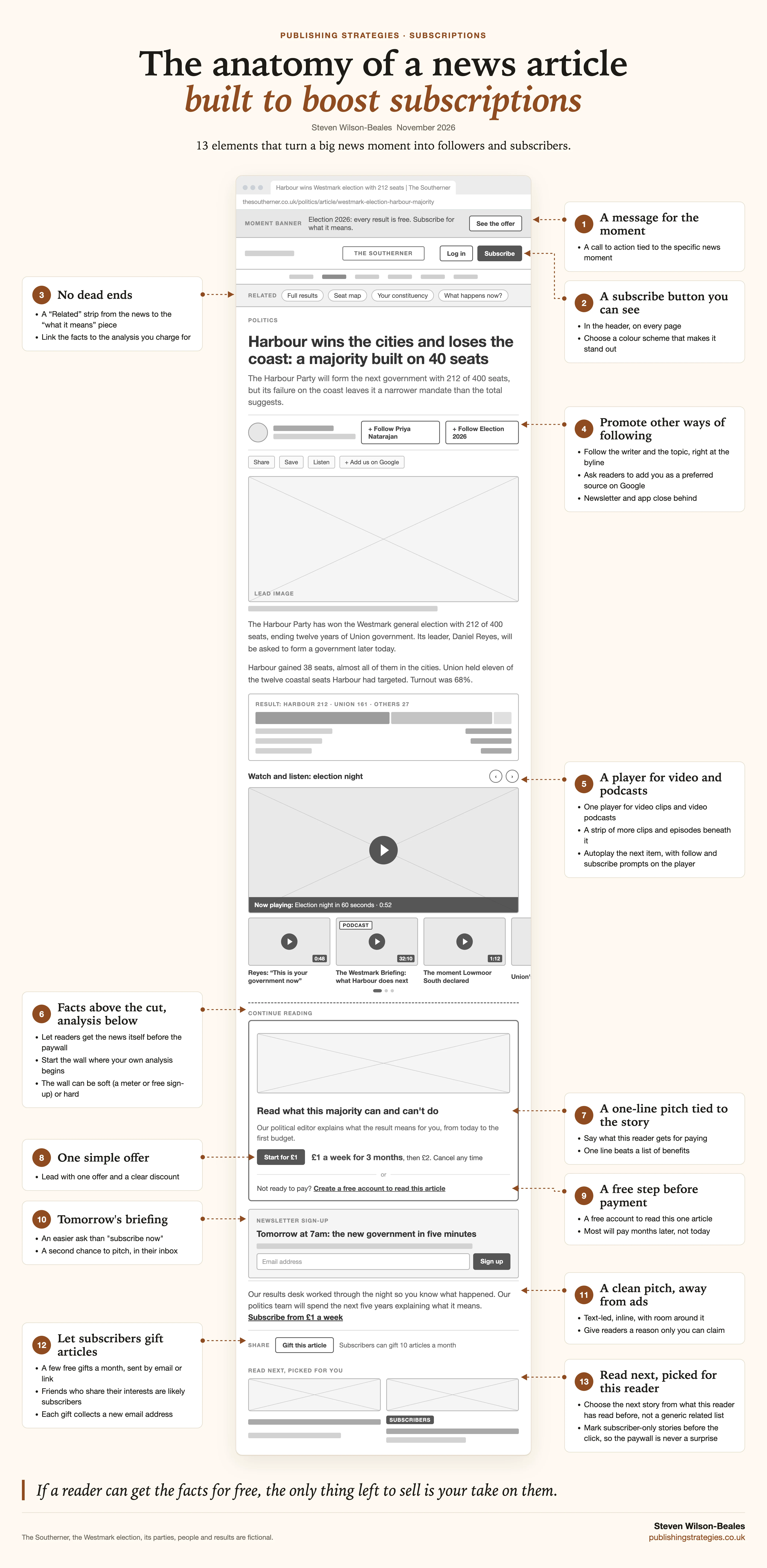
I wrote up my thoughts in my Publishing Strategies newsletter and gave it a suitably provocative title: Why news media failed at the midterms. I had lots of responses, so I thought I’d explore the topic further and challenge myself: what would the ideal news article template to boost subscriptions look like? So, I had a long think and made the wireframe below.
A few things to note
- This is very much for discussion. There may never be a perfect, universal subscription strategy, because every organisation is different. What looks insane to one newsroom may be entirely logical to another.
- Not every reader sees every element. The graphic shows all 13 at once so each one can be labelled. On a real site, the page should change with the reader. Someone arriving for the first time sees the facts, the paywall and a free sign-up. A subscriber sees no sales pitch at all, just gift links and what to read next. The point is not to detract from the news story itself. See who sees what.
Kicking things off…
1. A message for the moment. A call to action tied to the specific news moment, sitting above the masthead. Readers arrive for one reason on a big night, so speak to that reason. The typical North American publisher sold 43% more subscriptions around the 2024 US election than in 2019, according to INMA’s analysis.
2. A subscribe button you can see. In the header, on every page, in a colour that stands out. Almost every site I checked does this, including the FT and The Economist.
3. No dead ends. A “Related” strip that takes readers from the news to the “what it means” piece. Link the facts to the analysis you charge for.
4. Promote other ways of following. Let readers follow the writer and the topic right at the byline. Ask them to add you as a preferred source on Google, as the New York Times, the Telegraph and the Washington Post already do. Newsletter and app sign-ups come close behind.
Into the story…
5. A player for video and podcasts. One player that handles both video clips and video podcasts, with a strip of more clips and episodes beneath it. Autoplay the next item, and put follow and subscribe prompts on the player.
6. Facts above the cut, analysis below. Let readers get the news itself before the paywall, and start the wall where your own analysis begins. The wall can be soft (a meter or a free sign-up) or hard. If a reader can get the facts for free elsewhere, the facts aren’t what you’re selling.
Reaching the paywall…
7. A one-line pitch tied to the story. Say what this reader gets for paying, in one line. Most paywalls I saw used generic copy such as “unlimited access”, even on election night.
8. One simple offer. Lead with one offer and a clear discount. Every big subscription publisher I checked offers one, from the FT’s £1 for four weeks to the New York Times’ $1 a week.
9. A free step before payment. Offer a free account to read this one article. The Economist does almost exactly this: “create a free account to unlock just this article”. Registered readers are far more likely to pay, but not straight away. In Piano’s data, only about a fifth of those who convert in their first year do so in the first month.
After the story…
10. Tomorrow’s briefing. A newsletter sign-up is an easier ask than “subscribe now”, and it gives you a second chance to pitch in the reader’s inbox.
11. A clean pitch, away from ads. Text-led, inline, with room around it. Give readers a reason to pay that only you can claim.
12. Let subscribers gift articles. A few free gifts a month, sent by email or link. Friends who share a subscriber’s interests are likely subscribers too, and each gift collects a new email address. The FT, the Telegraph and the New York Times all offer this.
13. Read next, picked for this reader. Choose the next story from what this reader has read before, not a generic related list. Mark subscriber-only stories before the click, so the paywall is never a surprise.
Not every reader sees every element
Put all 13 elements in front of one reader and the page would feel like a sales funnel with a story squeezed into it. News teams would be right to object. The fix is to change the page depending on who’s reading.
| Reader | What changes for them | Asks they see |
|---|---|---|
| First-time or anonymous visitor | The moment message (1), the paywall pitch and offer (7, 8) and the free account (9) | Subscribe, or register free |
| Registered reader | The free-account ask disappears. Follow buttons (4), the newsletter (10) and a clean pitch (11) take over, with the paywall (7, 8) when their free articles run out | Follow, sign up to the newsletter, then subscribe |
| Subscriber | No paywall and no subscribe pitch. The header button becomes their account | Gift an article (12) |
Every reader gets the same core: the related strip (3), the video and podcast player (5), the facts above the cut (6) and a personalised read next (13). So the number of asks any one reader sees falls to two or three.
Two other points help with a sceptical newsroom:
- Some elements replace clutter rather than add to it. A personalised “Read next” replaces a generic related list, and a clean pitch replaces a block of sponsored links.
- Test one change at a time. Don’t launch all 13 together. Start with the two biggest gaps I found: a message for the moment and a pitch tied to the story. Add the rest only if conversions rise without engaged time falling.
For the full story of what the midterms revealed, read Why news media failed at the midterms.
Over to you
This model is for discussion, so tell me what I’ve missed or what your newsroom would never do. You can find me on LinkedIn or send me a message.
If you’d like help building a news page, or a wider content strategy, that turns big moments into subscribers, let’s talk.
Want to turn your next big news moment into subscribers? Book a free call and I'll look at your pages with you.
Got a question first? See the questions clients ask me.
Explore services
SEO, AI visibility and content strategy services
More thinking
Read more articles
- My favourite Journalism 2026 Predictions helpfully summarised, but not by AI! 08 Jan 2026
- Generative Engine Optimisation (GEO) Tips for Newsrooms 18 Dec 2025
- Why internal linking is the secret sexy sauce to strengthen your SEO, GEO and journalism 17 Dec 2025
- Navigating Zero-Click: Why Publishers Need to Swing From Reach to Relevance 16 Dec 2025
- AI Visibility is Not a Reset Button: What Publishing Leaders Need to Understand in 2026 16 Dec 2025