Content strategy is back. The hard part never went away.
Search, social feeds and now AI have all changed how audiences find brands. What every channel still rewards is a clear sense of what you stand for. That's why I've put positioning at the centre of an updated content strategy quad.
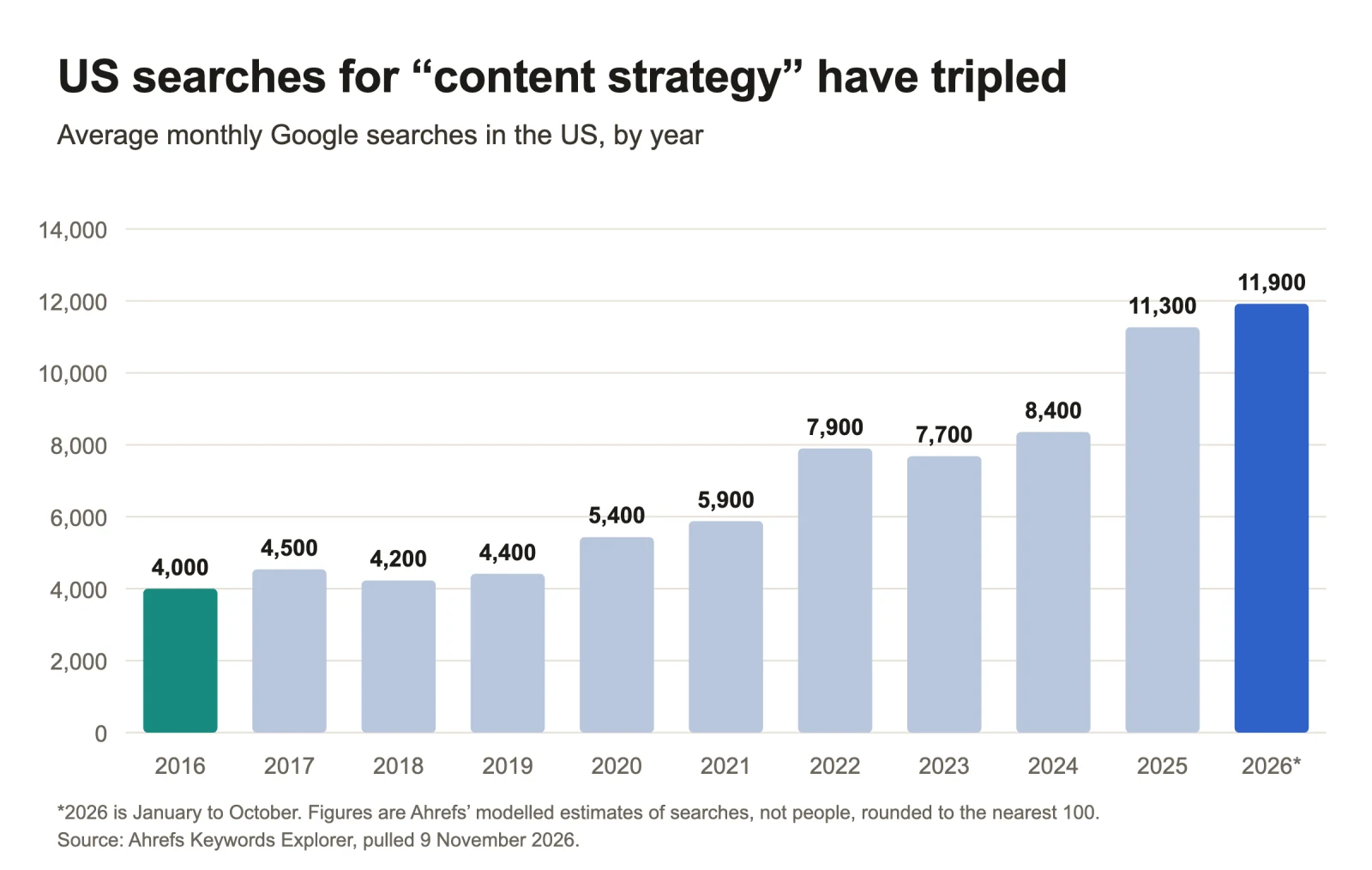
Content strategy is back in the spotlight. According to Ahrefs, US searches for the term reached around 12,000 a month in 2026, roughly three times the 2016 level.
The job market tells a more revealing story. Of 20 recent UK content strategist job ads I reviewed, 14 mentioned video and eight named TikTok, Reels or Shorts. Several wanted creator or user-generated content experience. Ahrefs also estimates that US searches for “youtube content strategy” have more than tripled since 2024.
But a TikTok plan isn’t a content strategy. The bigger challenge is deciding what your organisation stands for, and so what it should say, to whom, where and why. Zero-click search, changeable social feeds and AI answers all make that question harder to avoid. An influential model from 2018 is still the best place to start, and I think it’s worth updating for AI.
What content strategy actually is
Kristina Halvorson did more than anyone to establish content strategy as a discipline. She didn’t coin the phrase. That dates back at least to 2002, when Ann Rockley used it in the title of Managing Enterprise Content: A Unified Content Strategy, co-written with Pamela Kostur and Steve Manning.
But it was Halvorson’s 2008 A List Apart essay, “The Discipline of Content Strategy”, followed by her 2009 book Content Strategy for the Web, that helped bring the discipline into the mainstream. On her agency’s blog, one definition she offers is:
“Content strategy guides the creation, delivery, and governance of useful, usable content.”
She also says it connects content with business goals and user needs. Yet too often, content strategy gets reduced to an editorial calendar: what are we posting on Tuesday?
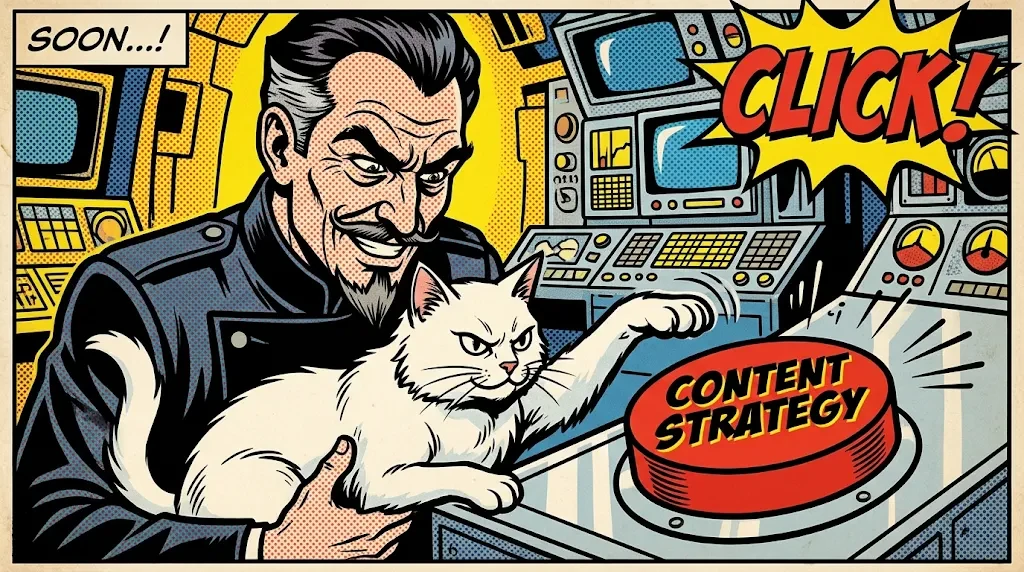
Today’s video-heavy job ads risk repeating that mistake. A channel plan needs a strategy behind it. Cue the evil mastermind hovering over a big red content strategy button.
And a white cat. Don’t forget the cat.
Why content strategy matters more now
Brands and publishers face a familiar problem with a new urgency: search is sending fewer people to their websites. SparkToro found that in the first four months of 2026, 68% of Google searches in the US ended without a click, up from about 60% in 2024. SparkToro suggests AI Overviews are likely to be a significant factor. In February 2026 Ahrefs found that when an AI Overview appears, the top-ranking page gets around 58% fewer clicks. Pew Research saw the same pattern in July 2025, when it found that people clicked a link on 8% of visits to a results page with an AI summary, against 15% without one. ChatGPT, Gemini and Perplexity now answer questions that used to send a visitor to your site.
That changes the questions clients ask me:
- How do we pivot when the clicks dry up?
- Do we need to rethink our brand positioning, or just our tactics?
- How much should we put into any one channel?
- Should we be making creator-style videos because that’s what the algorithm rewards?
These are content strategy questions. Answering them is one thing; getting an organisation to act on the answers is another.
That’s where ‘the quad’ comes in.
The content strategy quad for the AI era
Halvorson’s Content Strategy Quad is still one of the clearest ways to think about the discipline.
In Brain Traffic’s version, the top half covers content design (editorial strategy and experience design) and the bottom half covers the systems underneath it (content structure and process design).
I’ve used it for years to help clients connect their publishing challenges to practical decisions.
Much of AI search optimisation already fits within the model: structure addresses machine delivery, experience covers the wider ecosystem, editorial defines the voice, and process determines who decides. The original still holds up.
But the 2018 version predates ChatGPT and Google AI Overviews. It assumes people will find your content and visit your site. Today, AI systems can summarise your work and describe your brand without a click, often drawing on reviews, press coverage and community sites as well as your own pages. My updated quad therefore makes room for machine readability and external reputation. It also puts positioning at the centre: what you stand for is what you want people, and AI systems, to understand and repeat.
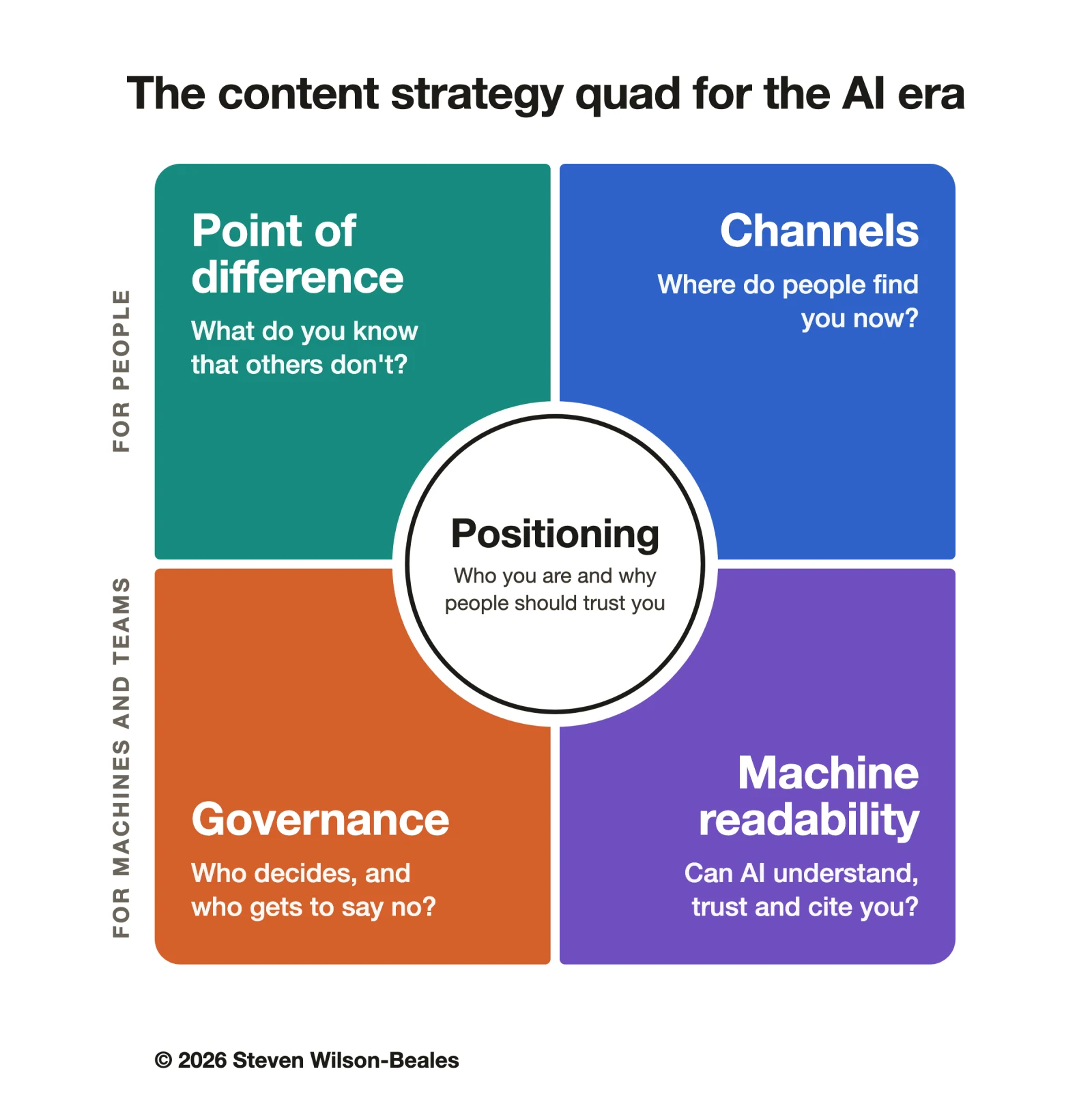
Positioning sits at the centre because it shapes everything else: what you make, where you show up and what gets repeated about you, by people and by AI. The top half is about people: your point of difference, and the channels where people find you. The bottom half is the system underneath, which both your teams and the machines that read your content rely on: machine readability and governance.
Each part answers one of those client questions. Here’s how to work through it, starting in the middle.
Start at the centre: positioning
Before you decide what to make, decide what you stand for. Who is this for, what do you know that others don’t, and why should anyone trust you on it?
This has always been the foundation, and every recent change in the market makes it more important. Search sends fewer clicks, feeds change their rules and audiences are spread across more channels, so you control less of how people find you. What you can control is what you stand for. A clear position works on every channel, gives people a reason to look for you by name, and survives any change to an algorithm. AI search makes this sharper still. What people and AI models say about you depends on how clearly and consistently you’ve said who you are. A brand with a sharp point of view gives search engines, AI assistants and readers something to repeat. A brand that chases every format sends mixed signals and gets summarised as generic.
Positioning is the claim you make about who you are and who you’re for. The next part of the quad is about proving it. Write your positioning down in a sentence or two. If your team can’t agree on it, that’s your first job, and no channel plan will fix it.
So, do you need to rethink your positioning or just your tactics? Positioning first. The tactics follow from it.
Point of difference
If positioning is the claim, your point of difference is the proof. It’s what you know that others don’t: first-hand expertise, original data and a voice people recognise. It builds on what Brain Traffic calls editorial strategy. It matters more now because generic content is exactly what an AI answer can replace.
Here’s the brand test: take away the logo. Take away the colours. Take away the name. Would anyone still know it’s you?
If the answer is no, you’re creating content for the platform, not building a brand. The format can belong to TikTok, but the message should be unmistakably yours.
Channels
Channels covers where people find you now: Google, AI answers, social feeds, YouTube, your newsletter and your site. It builds on Brain Traffic’s experience design, and it’s where two of those client questions live. Should we be making creator-style videos? And how much should go into any one channel?
Take video first. This is where I’d slow down. I’ve watched brands pour budget into short-form, creator-inspired video because a platform’s feed favours it this quarter. Some of it works. A lot of it looks like everyone else’s, sounds like no one in particular and has nothing to do with why customers chose the brand in the first place.
As I’ve said before, treat video with caution. It can be one of the best ways to demonstrate expertise, personality and credibility. Done badly, though, it can damage how people perceive your brand and burn through budgets. The risk is always letting the format decide the message. When any kind of algorithm becomes the brief, you’re optimising for a system you don’t control and can’t predict.
Feeds change their rules without notice. Your brand’s reason to exist shouldn’t.
A good video strategy sits within a wider content strategy. It starts from your positioning and your audience’s needs, then asks where video can best serve them.
None of this means avoiding creator-style video. A native style is often essential, because a polished brand ad looks out of place in a TikTok feed. The distinction to maintain is between style and substance: borrow the platform’s style, but keep the message yours. Treat social as the place you earn attention and build a community, then give people a reason to join something you own, such as a newsletter, an app or an account on your site.
Then there’s the question of money. How much should go into each channel? There’s no single right answer, because it depends on where your audience is and what each channel does for your business. Be wary of anyone who gives you a figure before they’ve looked at your data. A common rule of thumb is 70/20/10: about 70% of your effort on the channels that already work, 20% on promising ones you want to grow, and 10% on experiments. It’s a sensible way to make sure you keep testing new things without neglecting what pays the bills. Treat the numbers as a starting point and adjust them as your results come in.
Alongside that, I’d suggest four principles:
- Know which channels you own and which you rent. Your website, email list and app are yours. Social feeds, search results and AI answers are rented. Put enough into owned channels that one platform change can’t wipe you out.
- Judge channels by what they do for the business, not just their reach. A channel that drives sign-ups or sales earns more budget than one that drives views.
- Cap your dependence. If one platform delivers most of your audience, treat that as a risk to manage, not a success to celebrate. Many publishers learned this the hard way with Facebook, then with Google Discover.
- Ring-fence a slice for tests, with a date to review them. Then stop the ones that don’t work.
Machine readability
This is the part most content strategy advice leaves out, and it’s where AI has changed the job most. It builds on what Brain Traffic calls content structure, and adds something that model doesn’t cover: how you’re described on sites you don’t own. It asks one question: can AI understand, trust and cite you?
When someone asks ChatGPT or Google’s AI Mode about your sector, the answer is built from whatever those systems can find and piece together about you. If your site, social profiles, directory listings and press coverage all describe you differently, AI systems have to reconcile those inconsistencies. Brands that are easy to understand have a better chance of being described accurately, and of being cited.
It’s also a big part of the answer to the first client question: how do we pivot when the clicks dry up? If fewer people click, the answer itself needs to carry your name.
What I’d do:
- Decide your AI access policy first. Some publishers block AI crawlers or license their content instead. Letting AI search and answer tools read you is a different choice from letting your content train AI models, and both are commercial decisions. Make them on purpose, then apply the rest of this list to the tools you’ve chosen to let in.
- Keep the facts about you the same everywhere. Your name, what you do, who leads you and where you’re based should match on your site, your profiles, directories and anywhere else that describes you.
- Look after what others say about you. AI answers draw on much more than your own site: press coverage, reviews, Wikipedia, Reddit and other community sites. Earn coverage from sources your audience trusts, take part where people discuss your sector, and correct mistakes at the source.
- Make it clear who you are as an entity. An entity is anything search engines and AI models recognise as a distinct thing, such as a company, a person or a product. A clear About page, proper author pages and links to your official profiles help them connect the dots.
- Use structured data. This is code added to a page that labels what’s on it, such as an organisation, an article or a product, so machines don’t have to guess.
- Write content that stands on its own. AI answers tend to quote passages rather than whole pages (more in my GEO tips for newsrooms). Clear headings, a direct answer near the top and one idea per section make your content easier to quote.
- Check what AI already says about you. Ask ChatGPT, Gemini, Perplexity and Google’s AI Mode the questions your audience asks. Where they get you wrong, trace the mistake back to its source and fix it there.
Governance
Governance builds on what Brain Traffic calls process design. It asks who decides, and who gets to say no. It’s also where content strategy tends to succeed or fail, because the hard part is people.
Whenever I’ve worked through those questions with a client, the answer has involved more than a channel plan. It means getting the SEO, social, video, brand and product teams, along with editors, into one room to agree on what you’re trying to achieve.
Once you do that, you notice something. We may be living through a new digital era, but the problems in the room are familiar:
- Silos. Teams own channels, not outcomes, so each one optimises for its own numbers.
- Politics. Budgets and headcount are tied to channels, so changing the mix feels like a threat.
- Miscommunication. Information moves up and down, rarely across.
- Technology limits. The CMS, the analytics setup or the approval workflow can’t do what the strategy needs.
- No shared north star. Ask five people what the content is for and you’ll get five answers.
- Different languages. SEO talks about ‘intent’, brand focuses on ‘tone’, and product prioritises ‘conversion’. They may be working towards the same goal, but they’re speaking different languages.
- Stress, anxiety and fear. People worry that AI will take their job, or that the traffic drop will be pinned on them. This leads to people defending their patch.
None of this is new. Organisations have wrestled with it for as long as there have been organisations. AI hasn’t caused these problems. It has made them more expensive to ignore. Mastering content strategy is as much about handling this as it is about content.
Halvorson put governance in her very first definition, and it’s the part most companies skip. Governance sounds like bureaucracy. Done well, it’s the opposite: a short set of agreements that let people move quickly without tripping over each other.
This is how I’d set one up:
- Agree the north star first. One sentence on what your content is for and who it serves. Test every big decision against it.
- Build a shared glossary. Define the ten or so terms that different teams use in different ways. It feels trivial. It saves hours of meetings where people argue passionately while talking about different things.
- Form a small content council. Bring together one person from each team that creates or distributes content, and meet fortnightly. Its job is to make the cross-team calls no single team can make alone. In a newsroom, be clear about its remit: it covers distribution, standards and resources, not editorial judgement. The editor keeps the right to say no.
- Be clear about who decides. For each type of content, name who creates it, who approves it and who just needs to be told. Most friction comes from people discovering they were in the third group when they thought they were in the second.
- Publish standards everyone can see. Brand voice, quality bar, accessibility, how video fits the wider plan. Keep it short enough that people read it.
How you introduce the model matters more than the model itself. If governance arrives as a memo from above, people will see another layer of control and route around it. If they help build it, they’ll defend it.
How to fill in the quad with your team
The best tool I know for this is a book that’s been on my shelf for years: Gamestorming by Dave Gray, Sunni Brown and James Macanufo. It’s a collection of structured workshop games that get people talking, thinking and deciding together. That might sound frivolous. It isn’t. A good game lowers the stakes enough that people say what they really think, rather than what protects their team.
Four that work well, one for each part of the quad:
- Cover Story, for positioning. Teams imagine the magazine cover story about your brand a year from now, having succeeded. It surfaces the north star without anyone having to write a mission statement.
- Affinity Map, for your point of difference. Everyone writes down what they think makes you different on sticky notes, then the group clusters them. You quickly see where teams already agree, which is usually more often than they expect.
- Empathy Map, for channels. Map what your audience says, thinks, feels and does. It pulls every team back to the reader rather than their channel.
- Speedboat, for governance. Draw a boat (your content programme) and ask people to add the anchors holding it back. It’s a safe way to name politics, tech limits and fear without pointing fingers.
It also helps to get the problem out of people’s heads and onto a wall. A digital whiteboard such as Miro does this well, especially when half the team is remote. Draw the quad on the board and give each part its own space. Then map the content you have, the channels it goes to, the audience it serves and where the gaps are, all in one place everyone can see and edit.
It changes the conversation. When the SEO lead can see the video team answering the same audience question in a different way, the overlap stops being an argument and becomes a fix. When everyone can see the whole system, it’s harder to defend one corner of it.
Most Gamestorming games translate straight into Miro templates, so the two work well together.
Measure, review, repeat
The quad isn’t a one-off exercise. With fewer people clicking through, traffic alone doesn’t capture the value of your content, so measure more than clicks. Track how often you’re mentioned and cited in AI answers, the size of your owned audience, such as newsletter subscribers and registered users, and the revenue your content brings in.
Then review the quad every quarter with the same group. Look at what’s working, what’s changed in each part and what you’ll stop. Stopping things is often what teams find hardest, but it’s also what frees up resources. Repositioning isn’t something you do once.
The same job, a new moment
The tools have changed. Zero-click search, AI answers and short-form video have all changed where people find content. The job hasn’t. Getting the right content to the right people, in the right place, at the right time still depends on getting the right people in a room and helping them agree.
If one part of the quad matters most, it’s the centre. Channels will keep changing. Being clear about what you stand for is what lets you change with them, and agreeing on it is the part that still needs everyone in the room.
That was true when Ann Rockley put the phrase on the cover of her book in 2002. And I suspect it had been true long before anyone even thought to call it ‘content’.
Over to you
I’d like to hear how your team would fill in the quad, and what I’ve missed. You can find me on LinkedIn or send me a message.
If you’d like help working out your positioning, or a wider content strategy for your brand or newsroom, let’s talk. For more on what fewer clicks mean for publishers, read Navigating zero-click.
Want to put positioning at the centre of your content strategy? Book a free call and I'll work through the quad with you.
Got a question first? See the questions clients ask me.
Sources
- Ahrefs Keywords Explorer, “content strategy”, US monthly search volume, 2015 to October 2026, pulled 9 November 2026
- Google Trends, “content strategy”, worldwide and UK, 2004 to November 2026, pulled 6 and 9 November 2026
- Nick Malekos, “Google Trends is Broken, Why does it Matter?”, B2B Marketing Shots, June 2026
- Kristina Halvorson, “What Is Content Strategy? Connecting the Dots Between Disciplines”, Brain Traffic
- Kristina Halvorson, “New Thinking: Brain Traffic’s Content Strategy Quad”, Brain Traffic
- Ann Rockley, Pamela Kostur and Steve Manning, Managing Enterprise Content: A Unified Content Strategy (New Riders, 2002)
- Kristina Halvorson, “The Discipline of Content Strategy”, A List Apart, December 2008
- SparkToro, “In 2026, Less than One Third of Google Searches Still Send a Click”, June 2026
- Ahrefs, “Update: AI Overviews Reduce Clicks by 58%”, February 2026
- Pew Research Center, “Do people click on links in Google AI summaries?”, July 2025
- Dave Gray, Sunni Brown and James Macanufo, Gamestorming: A Playbook for Innovators, Rulebreakers, and Changemakers (O’Reilly, 2010)
Explore services
SEO, AI visibility and content strategy services
More thinking